8 min read
5 Best Fundraising Automation Tools for Raiser’s Edge NXT
Connecting a fundraising platform to Raiser’s Edge NXT does not necessarily eliminate the work behind the integration. After go-live, your team may...
Official Partner
We believe powerful tools shouldn't be complicated. SimpliPhi helps organizations work smarter, move faster, and drive real impact—simplifying the hard stuff so you can focus on what you do best.
5 min read
Evgeniya Salomatina
:
Updated on September 24, 2026
Table of Contents
Raiser’s Edge NXT queries can identify constituents who meet defined criteria and are useful for many fundraising workflows. The challenge begins when one campaign involves several overlapping donor audiences, priority rules, exclusions, multiple communication channels, or repeated validation before launch.
At that point, the question is “How should these audiences be prioritized in one campaign and multiple channels?”
In the context of this question, a CRM query is a constituent-selection tool. A donor segmentation platform adds a campaign-management layer around those selections, helping teams coordinate which audience takes precedence, validate overlap, manage exclusions, and apply approved segmentation decisions.
Raiser’s Edge NXT queries are useful when fundraising teams need to identify constituents who meet specific criteria.
Examples include:
The strength of a CRM query is that the selection logic stays close to the system of record. Data teams can define criteria, review the underlying logic, and use the results in downstream fundraising workflows.
AmpliPhi also preserves that relationship with the source system. Teams can open and review the source query directly from AmpliPhi rather than duplicating query logic in another system.
The difficulty appears when several valid queries have to work together.
Consider a donor who qualifies simultaneously as:
Each query may be technically correct. The operational question is different: Which audience should that donor belong to for this campaign?
Without a defined campaign hierarchy, teams may need to compare query outputs manually, build spreadsheet logic, create additional suppression rules, or make decisions outside the CRM.
This is where a prioritized donor segmentation strategy becomes useful. We cover the broader logic of hierarchy, overlap, and competing messages in Donor Segmentation Strategies for Nonprofits.
Segmentation platforms use CRM queries or reports as the source for audience logic. The difference is the level at which the work is managed.
| Campaign requirement | CRM queries | Donor segmentation platform |
|---|---|---|
| Identify records that meet defined criteria | Core function | Uses connected CRM data as input |
| Build several campaign audiences | Possible through separate queries | Organizes audiences within one campaign structure |
| Review overlap between audiences | Requires comparison across outputs | Designed to validate overlap across the campaign |
| Establish audience priority | Typically handled outside individual query results | Managed through hierarchy or processing priority |
| Apply inclusions and exclusions | Can be built into query logic | Managed as campaign-level rules |
| Coordinate channels with segmentation | Usually a separate workflow | Can connect campaign audiences with communication eligibility |
| Validate campaign-wide counts | Requires comparison of multiple outputs | Validates the combined segmentation structure |
| Apply final assignments back to the CRM | Depends on the workflow | A capability to evaluate when choosing a platform |
For a deeper comparison of software options, see 7 Best Donor Segmentation Tools for Nonprofits in 2026.
The right evaluation criteria depend on how complex your campaigns are and how much of the workflow your CRM team wants to keep inside the system of record.
For most fundraising operations teams, these nine areas are worth reviewing.
Can the platform work with current CRM queries, reports, or constituent data without requiring repeated spreadsheet exports?
This reduces version confusion and helps teams work from trusted source data.
Can teams define campaign audiences using the criteria already maintained in the CRM?
The platform should support the organization’s existing data model rather than force teams to rebuild all business logic elsewhere.
Can a team deliberately add or remove audiences from a campaign without rewriting every source query?
This is especially useful for campaign-specific exceptions and suppression logic.
What happens when one donor qualifies for several audiences?
A useful platform should provide a clear way to establish which treatment takes precedence.
Can users see when the same donor appears in multiple audiences before campaign activation?
This helps identify competing treatments and unexpected gaps.
Can approved segmentation decisions be applied back to the CRM or connected campaign workflow?
This matters when the CRM remains the system of record for appeals, campaign members, or other campaign assignments.
Can teams separate who the donor is from how the donor should be contacted?
That distinction becomes important when direct mail, email, phone, or other communication channels are coordinated around the same donor audience.
For a deeper annual-giving example, see How to Segment an Annual Giving Campaign: The Complete Guide.
Campaign planning does not always require every audience to recalculate continuously.
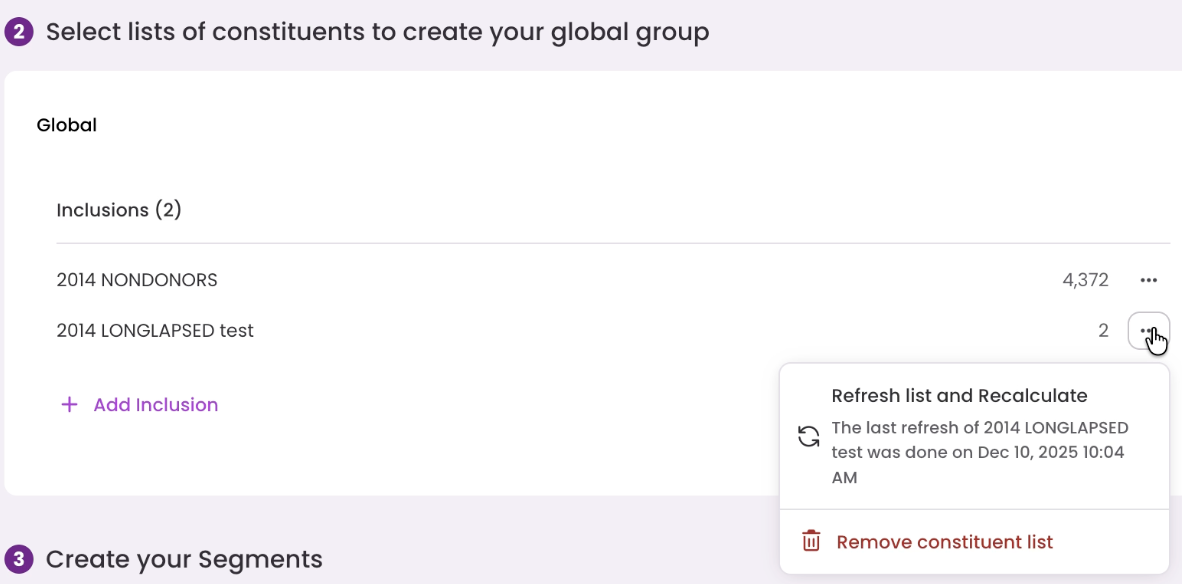
Teams should understand when source data refreshes, which campaign objects are recalculated, and whether they can control refresh timing.
AmpliPhi’s current approach is explained in AmpliPhi Performance Update: Smarter Refresh Logic, Faster Performance and the more detailed article on refresh logic and campaign control.
Can fundraising staff understand audience definitions, counts, overlap, and campaign readiness without needing to rebuild CRM logic themselves?
It means making campaign decisions visible to the people responsible for executing the campaign.
Imagine a donor qualifies for:
That hierarchy is organization-specific. Another nonprofit might set a different order based on its stewardship model, campaign strategy, or communication policy.
The important point is that query accuracy does not automatically resolve campaign priority.
For more on why donors with similar giving behavior may still require different treatment, see Why Donors Who Give the Same Amount Need Different Strategies.
CRM queries may be sufficient when:
In those cases, adding another application may not improve the workflow.
The need usually becomes clearer when the campaign workflow itself is creating friction.
Examples include:
If your team is still determining whether its process is ready for this type of workflow, use our segmentation readiness guide.
AmpliPhi is a donor segmentation platform for nonprofit teams that need to build, prioritize, validate, and apply campaign audiences using connected CRM data.
With Raiser’s Edge NXT, the source queries remain part of the CRM workflow. AmpliPhi provides the campaign-management layer around them.
Teams can use the application to:
For teams using Salesforce instead, see how Salesforce Reports work as an audience source in AmpliPhi.
Hospital foundations often have several donor relationships operating at the same time, including grateful patients, recurring donors, event participants, tribute donors, community supporters, and major-gift prospects.
That makes audience priority especially important.
Rather than repeating the hospital-specific segmentation framework here, see Build Smarter Segmentation for Hospital Foundations and our guide to first-time donor segments for hospital foundations.
Raiser’s Edge NXT queries answer:
Which constituents meet these criteria?
A prioritized donor segmentation strategy answers:
How should all of these eligible audiences work together in this campaign?
A donor segmentation platform is most useful when fundraising teams need to manage that second question repeatedly and transparently, while keeping the CRM as the system of record.
If you want to build your first campaign in AmpliPhi at no cost, book a discovery call.
8 min read
Connecting a fundraising platform to Raiser’s Edge NXT does not necessarily eliminate the work behind the integration. After go-live, your team may...
2 min read
Why this matters for nonprofits Nonprofits must carefully respect donor communication preferences to stay compliant and build trust. Consent in...
1 min read
3 min read
AmpliPhi.app now allows fundraising teams to open a query directly in its source system with a single click and selectively refresh that query just...
2 min read
What This Feature Enables With field deletion in Data Flow, teams can: Remove custom fields added temporarily during multi-step integrations Delete...
2 min read
1. Data Silos Are Hindering Your Insights If your CRM, finance software, email tools, and fundraising platforms operate in isolation, your team...
1 min read
4 min read
Blackbaud has announced that support for Raiser’s Edge NXT Database View and Database View-dependent functionality will end on September 15, 2027....