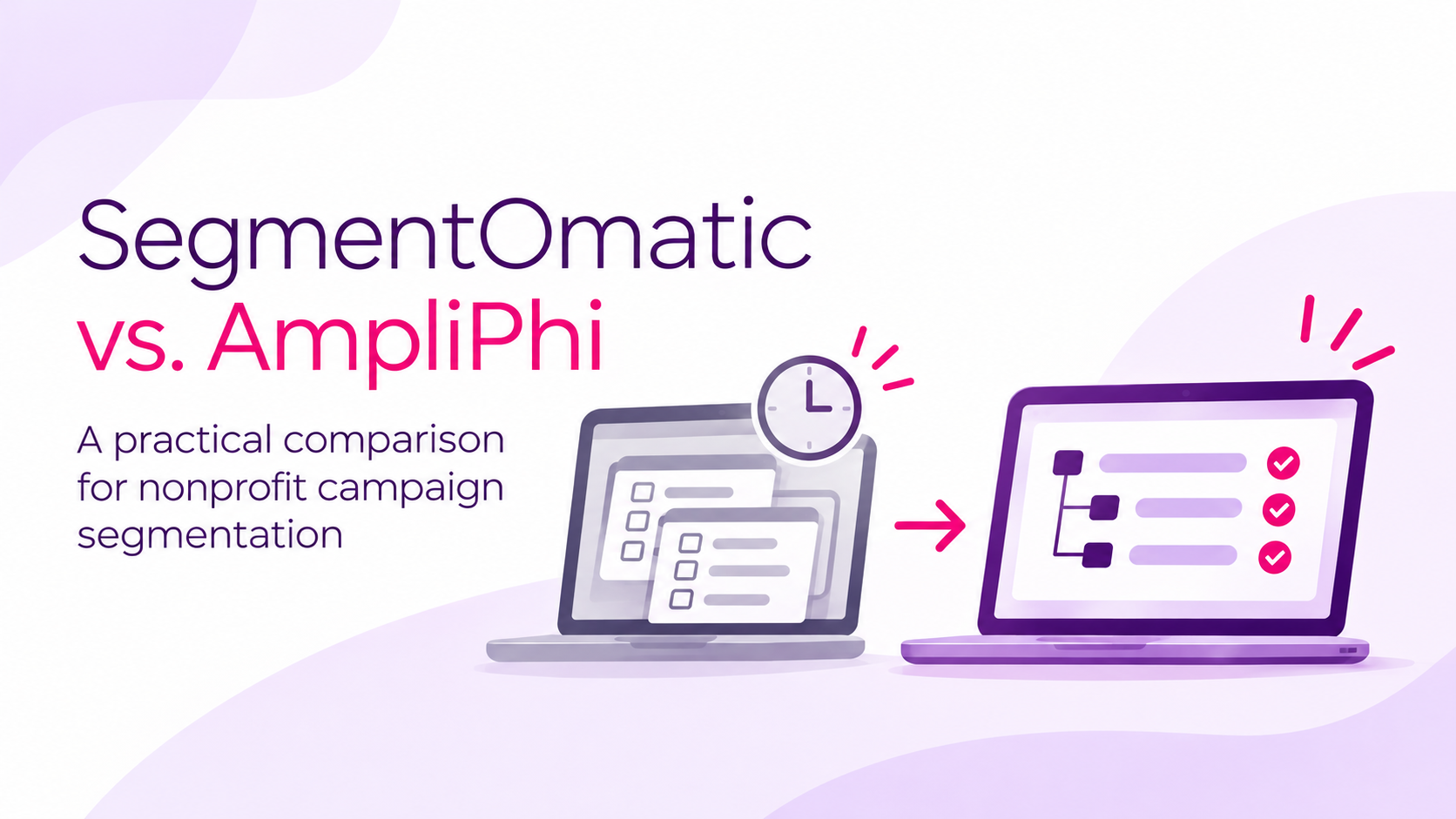
SegmentOmatic vs. AmpliPhi: A Leadership Guide to Donor Segmentation
Compare SegmentOmatic and AmpliPhi through one foundation’s workflow: overlapping donor audiences, slow calculations, barcode exports, and campaign...
Official Partner
We believe powerful tools shouldn't be complicated. SimpliPhi helps organizations work smarter, move faster, and drive real impact—simplifying the hard stuff so you can focus on what you do best.
14 min read
Evgeniya Salomatina
:
Published
Updated
Donor segmentation tools help nonprofit teams select and organize audiences for fundraising campaigns. The right choice depends on whether you need a fundraising CRM, AI-assisted audience recommendations, or a dedicated workspace for planning and validating audiences alongside your existing CRM.
This guide compares seven options: AmpliPhi.app, Avid AI, Bloomerang, Virtuous, Salesforce Nonprofit Cloud, Bonterra EveryAction, and Blackbaud Raiser’s Edge NXT. We explain what each is designed to do, who may find it useful, and what to check before choosing.
Learning how to segment donors? Explore practical fundraising guidance in Segmentation Academy.
Evaluating segmentation software? Book an AmpliPhi demo to discuss your campaign workflow.
The first decision is whether you need a new fundraising CRM or a dedicated way to prepare campaign audiences using the CRM you already have.
For RE NXT teams with recurring direct-mail and email appeals: See an RE NXT campaign-audience workflow in AmpliPhi, including exclusions, segment priorities, count validation, and CRM assignments.
SimpliPhi makes AmpliPhi.app, one of the products in this comparison. We selected these seven options because they represent different ways nonprofit teams build or use donor audiences, including dedicated segmentation software, AI-assisted platforms, and fundraising CRMs. We reviewed publicly available vendor information against the criteria below. The numbered order is for navigation and is not a performance ranking. Features and availability can change, so confirm your requirements with each vendor.
You deserve tools that match the way your fundraising team actually works, not platforms that force you to wait on IT or export to spreadsheets before every campaign. We evaluated these seven platforms based on criteria that matter to development operations teams running multichannel appeals on tight timelines.
AmpliPhi.app is a donor segmentation platform for nonprofit teams that need to organize, prioritize, and validate campaign audiences using connected CRM data. It connects to Raiser’s Edge NXT or Salesforce and is designed to work alongside a CRM rather than replace it.
Unlike a CRM query that identifies records matching a set of conditions, AmpliPhi manages the relationship between multiple campaign audiences. Teams can define inclusions and exclusions, establish processing priority, validate audience counts and overlap, apply communication-channel rules, and push approved segmentation details back to the CRM.
The Fundraising Effectiveness Project estimated that overall donor retention was 42.9% in 2024. New-donor retention was only 19.4%, compared with 69.2% for repeat donors. These figures demonstrate why recognizing donor history and lifecycle stage matters when building campaign audiences.
SimpliPhi built AmpliPhi to put segmentation control in the hands of fundraisers. Your team can review audience counts before campaigns launch and push approved segmentation detail back to your CRM.
Pros:
Cons:
Preparing a hospital foundation campaign? Download our hospital foundation segmentation guide to review acquisition sources, second-gift follow-up, and campaign audiences with your team.
Avid is an AI-powered fundraising platform that connects data from CRMs, email platforms, advertising tools, online giving systems, and other sources. Its Pathways functionality allows fundraising teams to create dynamic donor audiences and keep them synchronized as donor data and behaviour change.
Teams can build audiences manually or describe the audience they need in plain language. Avid AI then suggests audience filters, a name, and a potential value proposition. Users can review and edit the suggested definition before deploying the audience to a connected platform or exporting it as a CSV.
Avid is broader than a dedicated segmentation platform. In addition to audience building, it provides fundraising insights, benchmarks, playbooks, campaign recommendations, and direct-mail functionality. This makes it suitable for organizations looking for an AI-supported fundraising operating system rather than a tool focused specifically on campaign segmentation hierarchies.
Pros:
Cons:
Bloomerang includes a built-in engagement score that tracks donor interactions across email opens, event attendance, and giving frequency.
The CRM's segmentation is filter-based, so you select criteria like giving range, last gift date, or communication preferences to build lists. These lists can be exported for use in email or mail campaigns.
Pros:
Cons:
Virtuous CRM includes automation workflows that trigger actions based on donor signals like giving milestones, lapsed periods, or engagement changes. Segments in Virtuous are built through a query interface that allows and/or logic on contact fields and giving history.
The platform connects to email tools and supports multichannel outreach, though segment activation still requires setup across separate modules for each channel.
Pros:
Cons:
Salesforce Nonprofit Cloud offers reports, dashboards, and segmentation through its standard reporting engine and campaign management module. Organizations with a trained Salesforce administrator can build custom segments using any field in the database.
The platform's strength is its configurability. With AppExchange apps and custom objects, Salesforce can handle complex segmentation logic. That configurability comes with administrative overhead, however, which means fundraising staff rarely build segments without technical support.
Pros:
Cons:
Bonterra EveryAction is a nonprofit CRM and engagement platform that combines donor management, fundraising, email, mobile messaging, advocacy, reporting, and campaign workflows. Its Create a List functionality allows teams to build and save supporter audiences using criteria stored in EveryAction.
EveryAction also includes Bonterra Que, an AI-powered fundraising assistant. Users can describe the donors they want to reach in plain language, and Que creates a proposed segment using giving behavior, engagement history, and supporter interests. Teams can review the logic, refine the criteria, save the segment, and use it across EveryAction’s communication channels.
Unlike AmpliPhi, which adds a dedicated segmentation workspace to an existing Raiser’s Edge NXT or Salesforce environment, EveryAction provides segmentation as part of a broader CRM, fundraising, and engagement platform.
Pros:
Cons:
Raiser's Edge NXT includes a query module that allows development teams to select donors using criteria like gift amount, fund, campaign, and constituent attributes. For organizations already in the Blackbaud ecosystem, queries connect to exports and batch processing for campaign execution.
Raiser’s Edge NXT supports static and dynamic queries, Lists built from eligible queries, and Managed Lists for curated inclusion and exclusion decisions. These native features may be sufficient for many constituent-selection workflows. Teams should compare the complete campaign process, including overlap resolution, segment processing priority, channel-specific preparation, and approved CRM assignments, before deciding whether an additional workspace is useful.
Pros:
Cons:
| Platform | Product type | Hierarchy and prioritization | Connected data | Channel preparation or deployment | AI-assisted audiences | Best fit |
|---|---|---|---|---|---|---|
| AmpliPhi | Dedicated segmentation platform | Yes | Direct CRM connection | Prepares and pushes segmentation data | No | Fundraiser-controlled campaign segmentation |
| Avid AI | AI fundraising platform | Different audience model | Connected fundraising stack | Synchronizes audiences to connected platforms | Yes | AI-assisted audiences and campaign recommendations |
| Bloomerang | Nonprofit CRM | Filter-based audiences | Native CRM data | CRM and connected tools | Yes, conversational reporting | Smaller teams using Bloomerang |
| Virtuous | Responsive fundraising CRM | Query and workflow based | Native CRM data | Built-in and connected workflows | Confirm exact functionality | Mid-sized responsive fundraising teams |
| Salesforce Nonprofit Cloud | Configurable nonprofit CRM | Custom configuration | Native Salesforce data | Requires Salesforce tools or integrations | Depends on configuration | Teams with Salesforce expertise |
| Bonterra EveryAction | Fundraising CRM/platform | List-based | Native platform data | Platform-dependent | Confirm exact functionality | Teams using EveryAction |
| Raiser’s Edge NXT | Fundraising CRM | Query, Lists, and Managed Lists | Native CRM data | Exports and Blackbaud tools | Confirm exact functionality | Organizations already using Blackbaud |
Relevant communication based on giving history and engagement can support stronger donor relationships and retention. According to the Fundraising Effectiveness Project, new-donor retention was 19.4% in 2024, meaning approximately one in five new donors gave again the following year.
Segmentation can help address that challenge by matching communication to donor context. A first-time giver who responded to a peer-to-peer campaign needs a different follow-up than a multi-year mid-level donor approaching a major gift ask.
When your segmentation strategy accounts for giving level, recency, channel preference, and campaign history, you create the conditions for retention to improve. The difference between a donor who feels seen and one who receives irrelevant outreach is often just one well-timed, well-targeted message.
Start with how your team actually runs campaigns. If you rely on a data specialist to pull lists, a tool that puts segmentation directly in fundraisers' hands can remove a bottleneck and shorten your time to launch.
Consider whether you need hierarchy and prioritization. Campaigns that span multiple channels and multiple asks need clear rules to prevent donors from receiving conflicting messages. A tool with built-in prioritization lets you set those rules in one place, while a flat query tool may leave you managing conflicts in spreadsheets.
Ask how each tool connects to your data and when it refreshes. Static list exports go stale quickly, especially during active campaigns when donor records are changing. Being able to refresh and review audience counts against current CRM data before execution reduces the risk of working from outdated lists.
AmpliPhi was built to give nonprofit fundraising teams the ability to build, validate, and prepare donor segments for campaign execution with less reliance on IT or spreadsheet exports.
Native CRM Query and Lists features can address many selection tasks. AmpliPhi is worth evaluating when teams need to organize several overlapping audiences into one campaign, establish processing priorities, apply channel rules, review counts, and prepare repeatable CRM assignments. Whether this additional workflow is valuable depends on the campaign’s complexity and the capabilities already configured in the CRM.
AmpliPhi connects to Raiser’s Edge NXT and Salesforce, so teams can refresh audiences from current CRM data, review counts and overlap, and push approved segmentation detail back to the CRM.
If you want to see how this would work for your campaigns, book an AmpliPhi demo to walk through your workflow.
Donor segmentation is the practice of dividing your donor file into distinct groups based on giving behavior, engagement level, and communication preferences. Segmentation tools help teams build and validate those groups from CRM data.
Segmented outreach means donors receive messages that match their relationship with your organization, which can support stronger retention and higher lifetime value.
No. AmpliPhi.app is a donor segmentation platform designed to work alongside an existing CRM. SimpliPhi identifies Raiser’s Edge NXT and Salesforce as supported source systems; confirm the details of your configuration with SimpliPhi.
AmpliPhi focuses on fundraiser-controlled campaign segmentation, including parent-and-child hierarchies, inclusion and exclusion rules, processing priority, catch-all groups, channel planning, audience validation, and pushing finalized segmentation data to the CRM. Avid AI takes a broader AI-assisted fundraising approach, generating dynamic audiences, identifying campaign opportunities, and synchronizing audiences with connected engagement platforms.
AmpliPhi adds segmentation hierarchy, inclusion and exclusion rules, donor-first channel planning, and campaign execution readiness on top of your existing CRM data. CRM-native tools often return individual query or list results, so prioritizing donors across several overlapping audiences may require additional manual work.
With AmpliPhi, teams manage segment priority, exclusions, and communication-channel rules together, then prepare assignments for the existing CRM. Compare this with the latest native Query, Lists, and Managed Lists functionality before purchasing an additional platform.
It depends on campaign complexity. Even organizations with fewer than 5,000 donors may run campaigns across multiple channels. If your team coordinates several overlapping audiences or channels, a dedicated platform can help you apply priorities and review audience counts. Teams running simple, single-channel campaigns may find native CRM tools sufficient.
AmpliPhi connects to Raiser's Edge NXT and Salesforce as primary source systems. SimpliPhi continues to expand integration options based on the nonprofit sector's most-used platforms. You can check current availability on the AmpliPhi website.
Timing depends on your CRM configuration and campaign needs. The typical path is to connect your CRM, select a template from the gallery, and customize your audience hierarchy. SimpliPhi's team supports you through setup with guided onboarding and in-app chat.
Raiser’s Edge NXT queries can identify constituents that meet defined criteria and are useful for many fundraising workflows. A dedicated donor segmentation platform adds another layer for campaigns that involve multiple overlapping audiences, processing priority, inclusions and exclusions, validation, communication-channel rules, and applying final segmentation decisions back to the CRM.
Compare SegmentOmatic and AmpliPhi through one foundation’s workflow: overlapping donor audiences, slow calculations, barcode exports, and campaign...
AmpliPhi helps nonprofit and hospital foundation teams prioritize, validate, and apply campaign audiences alongside Raiser’s Edge NXT or Salesforce.
Download a practical donor segmentation guide for hospital foundations. Review acquisition sources, donor follow-up, and audiences before your next...
Nonprofit teams live inside a thousand small deadlines. A campaign segment finishes building, a template-generated campaign is ready, an invoice is...
A hero’s journey in five minutes: how a Montreal hospital foundation used AmpliPhi to rethink donor segmentation and grow appeal revenue by 72%.
How Hospital Foundations Can Improve Donor Retention Through Segmentation
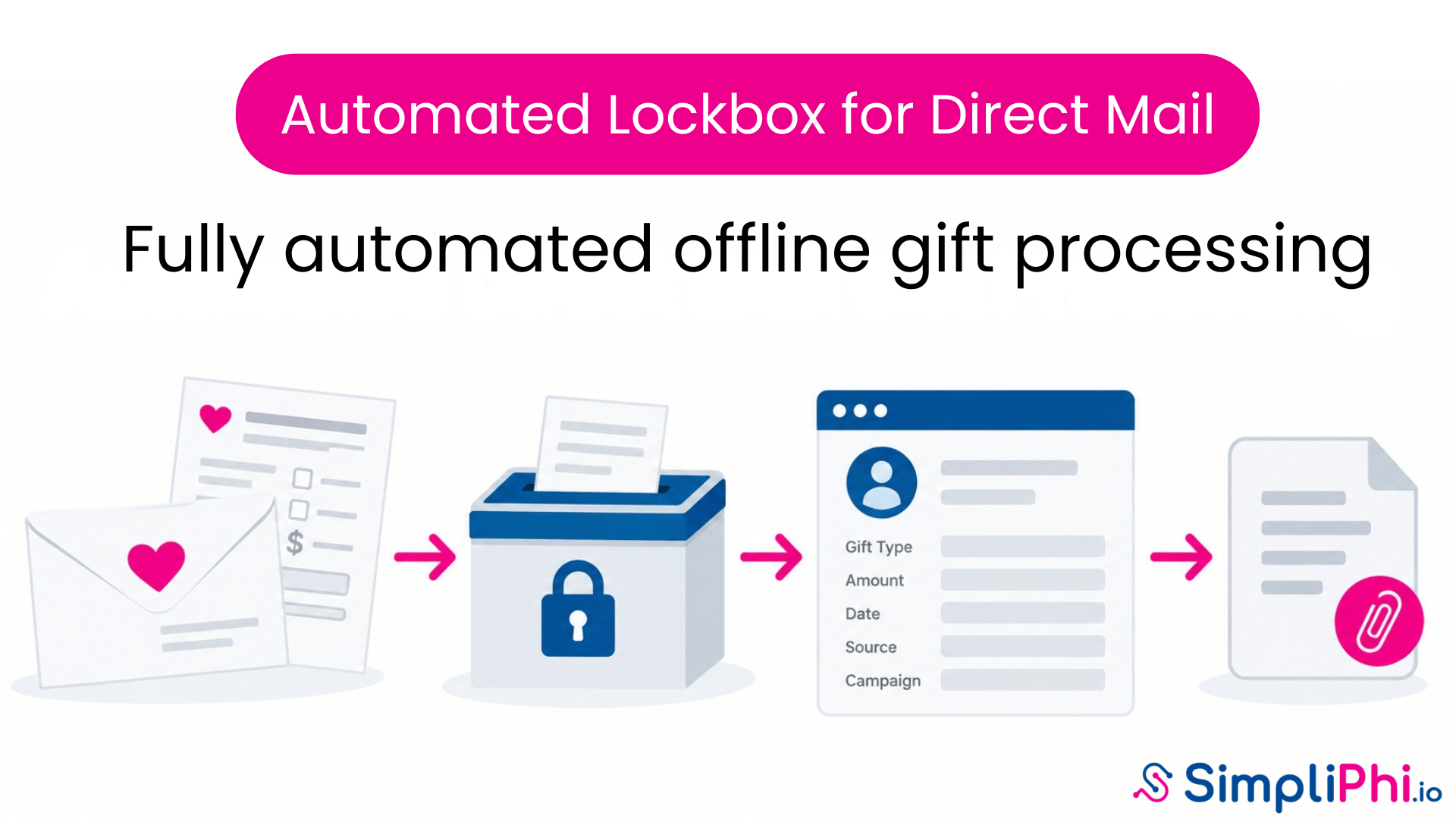
Learn how nonprofits can automate direct mail gift processing from lockbox receipt through Raiser’s Edge NXT gift creation and document management.
How Nonprofits Can Personalize Donor Outreach and Boost Engagement with Smarter Segmentation.