How Do Nonprofits Keep Donor Data Consistent Across Multiple CRMs?
Learn how nonprofits synchronize donor data across multiple CRMs, reduce duplicate records, protect data integrity, and improve reporting consistency.
Official Partner
We believe powerful tools shouldn't be complicated. SimpliPhi helps organizations work smarter, move faster, and drive real impact—simplifying the hard stuff so you can focus on what you do best.
Duplicate constituent records create confusion, increase administrative work, and make it harder to trust fundraising data.
As donor information enters your CRM through online donations, events, peer-to-peer campaigns, forms, and multiple fundraising systems, maintaining clean records becomes increasingly difficult.
Charity Automator Data Flow uses matching logic designed to help reduce potential duplicate records and support cleaner, more reliable constituent data.
When donor information enters the CRM through different channels, it is common for multiple records to be created for the same constituent.
Over time, duplicate records accumulate and become increasingly difficult to manage.
Fundraising teams often experience:
❌ Multiple records for the same donor
❌ Incomplete constituent histories
❌ Conflicting donor information
❌ Additional manual review work
❌ Difficulty producing accurate reports
❌ Reduced confidence in fundraising data
What begins as a small data quality issue can eventually affect fundraising operations across the organization.
Fundraising teams rely on accurate constituent information to make decisions, build audiences, communicate with supporters, and measure results.
When duplicate records exist:
❌ Donor histories become fragmented
❌ Reporting becomes less reliable
❌ Segmentation becomes more difficult
❌ Staff spend time investigating records
❌ Donor experiences may become inconsistent
The challenge grows as fundraising programs expand and more systems contribute data to the CRM.
Without a consistent process for identifying potential duplicates, data quality can gradually decline over time.
Many organizations address duplicate records through periodic database cleanup initiatives.
While these projects can improve data quality temporarily, they often require significant staff effort and provide only short-term results.
❌ New records continue entering the CRM every day.
❌ New fundraising platforms are added.
❌ New campaigns generate new constituent data.
By the time one cleanup project is completed, new duplicate records may already be appearing.
A more sustainable approach focuses on ongoing identification, monitoring, and management of potential duplicates.
Charity Automator Data Flow helps organizations establish more consistent data quality processes by applying matching logic as fundraising data moves between systems.
Rather than relying solely on manual review after records have already entered the CRM, Data Flow can evaluate incoming data against existing records using configurable matching rules.
This helps identify potential duplicate records earlier in the process and supports cleaner constituent data over time.
Data Flow helps organizations:
No system can completely eliminate duplicate records, but organizations can significantly reduce their frequency and impact through consistent processes and automation.
Improve Donor Experience
Support a more complete view of donor relationships across fundraising systems.
Increase Confidence in Reporting
Work from cleaner constituent data and reduce reporting inconsistencies.
Reduce Administrative Work
Spend less time identifying and investigating potential duplicate records.
Strengthen Data Governance
Create repeatable processes that support long-term data quality.
Improve CRM Data Quality
Help maintain more accurate constituent information as data enters the system.
Support Scalable Growth
Manage increasing data volumes without proportionally increasing manual cleanup efforts.
01
Data Flow receives information from fundraising platforms, files, forms, and other systems.
02
Incoming records are evaluated against configurable matching criteria.
03
Records that meet defined matching thresholds can be flagged for review or processed according to business rules.
04
Organizations gain a more consistent process for managing constituent data over time.
Give your fundraising team greater confidence in constituent data while reducing the administrative effort required to manage potential duplicates.
Matching rules can evaluate constituent information such as names, email addresses, phone numbers, addresses, and other data points.
Mapping rules are established during implementation through collaboration between your team and our data specialists. We work with stakeholders who understand your systems, data structure, and business processes to define how information should be mapped, transformed, validated, and delivered.
Matching and review processes can be configured according to organizational requirements and data governance practices.
Yes. Organizations can establish review workflows and validation processes before taking action on potential duplicates.
No. Duplicate records can occur in any system. Data Flow uses matching logic designed to help reduce potential duplicates and support cleaner data management practices.
Yes. Data Flow helps organizations manage how data is moving between fundraising platforms and CRM systems, where duplicate records commonly originate.
No. Data Flow supports a wide range of fundraising systems and nonprofit data workflows.
Learn how nonprofits synchronize donor data across multiple CRMs, reduce duplicate records, protect data integrity, and improve reporting consistency.
Automate nonprofit data imports from CSV files, spreadsheets, and fundraising platforms. Reduce manual work and improve data accuracy.
Learn why donor data differs across fundraising platforms and CRMs and how controlled automation improves matching, coding, validation, and...
Improve fundraising operations through CRM optimization, data cleanup, gift structure reviews, and major giving pipeline improvements.
Compare 5 fundraising automation tools for Raiser’s Edge NXT: Data Flow, Omatic, SmartSYNC, Importacular and BrightVine.
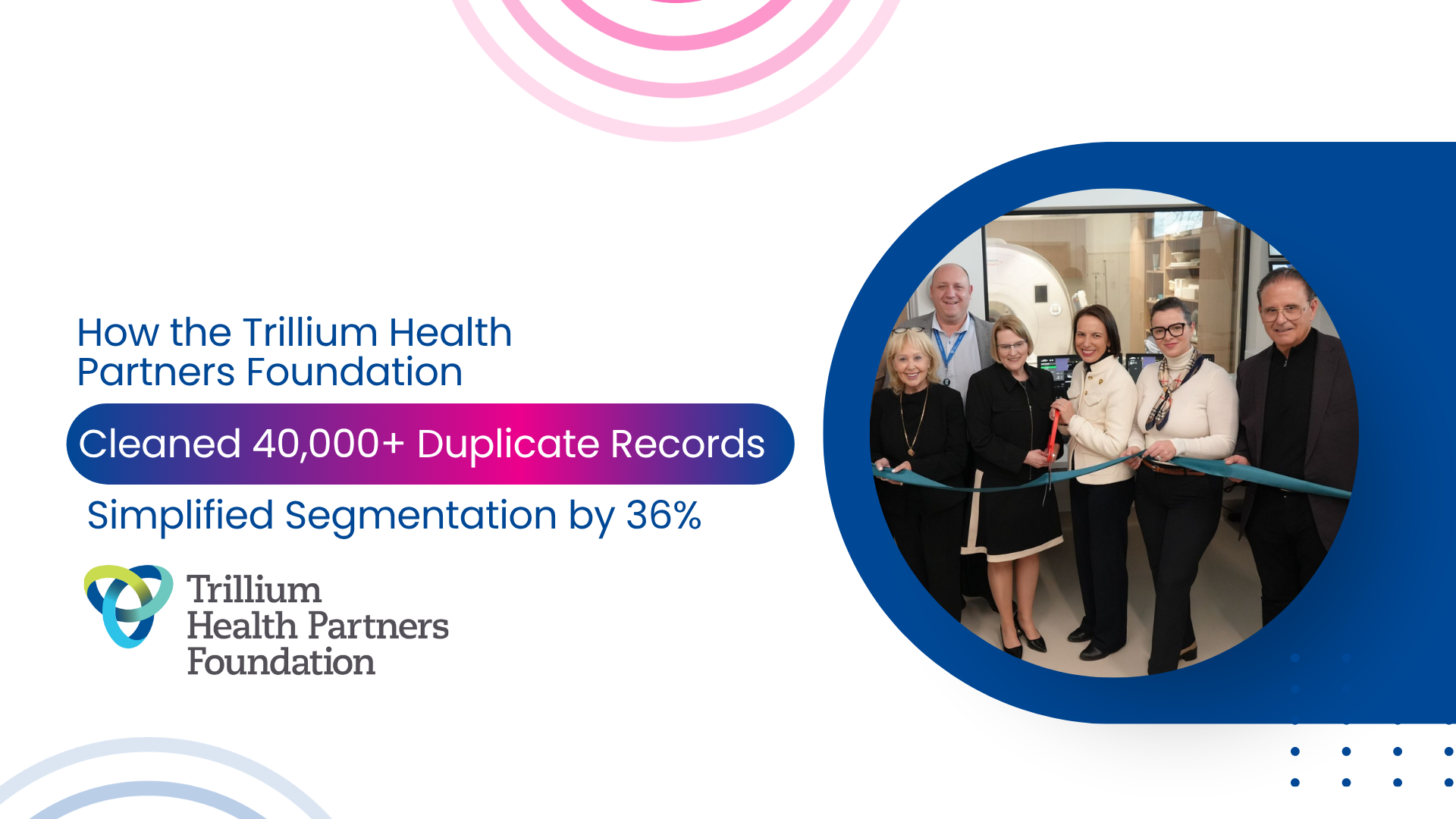
Improving donor data accuracy at Trillium Health Partners Foundation: 40,000+ duplicates removed, cleaner segmentation, and more reliable campaign...
Today, we would like to share details about the powerful capabilities included in the Charity Automator Data Flow. Nonprofits can delete individual...
Plan and execute nonprofit CRM migrations with confidence. Reduce risk, preserve data quality, and support user adoption throughout implementation.