 Stefan Karnyaczki
2 min read
Why Doesn't My Donor Data Match Across Different Fundraising Systems?
 SimpliPhi : Jul 2, 2026, 2:53:00 PM
Official Partner

We believe powerful tools shouldn't be complicated. SimpliPhi helps organizations work smarter, move faster, and drive real impact—simplifying the hard stuff so you can focus on what you do best.
Charity Automator Data Flow controls how transactions move from fundraising platforms into the CRM.
The process follows seven connected stages.
Data Flow collects transactions from connected fundraising platforms according to the agreed integration design and processing schedule.
This reduces the need for staff to download, prepare and manage spreadsheets before information can be imported into the CRM.
Incoming constituent information is compared with existing CRM records using the organization’s matching criteria.
This helps prevent unnecessary duplicate records and supports a more consistent constituent history.
Data Flow applies the organization’s campaigns, funds, appeals, packages, gift types, payment methods and other required revenue rules.
Applying these rules consistently helps fundraising and finance teams work with more reliable revenue information.
Required values, mappings and processing conditions are checked before data moves to the CRM.
When a transaction does not meet the established requirements, it can be identified before incomplete or incorrectly coded information reaches the destination system.
Validated transactions move to the CRM according to the processing schedule established with the organization.
The appropriate schedule depends on transaction volumes, fundraising activities, reporting needs and the systems involved.
Transactions that cannot be processed as expected are clearly identified. They remain recoverable after the underlying issue is reviewed or corrected.
This gives staff a clear path for resolving incomplete information, uncertain matches or unexpected values.
Source IDs, batch information and processing history help teams connect CRM records with their originating transactions.
These details make it easier to reconcile activity, investigate differences and understand how a transaction was processed.
Together, these stages create a repeatable path from the fundraising platform to the CRM, reducing spreadsheet work, inconsistent coding and unexplained discrepancies.
Nonprofits typically evaluate a new approach when their integration process creates too much operational work or does not provide enough confidence in CRM data.
Staff may still need to export files, reorganize columns, correct values, apply coding and prepare imports.
These steps take time and create additional opportunities for errors. The workload becomes especially difficult during giving days, emergency appeals, events and year-end fundraising periods, when transaction volumes increase and current information becomes particularly important.
When coding is applied manually, transactions can arrive in the CRM with inconsistent campaigns, funds, appeals, packages or gift types.
When importing depends on staff availability, CRM information may also fall behind the fundraising platforms where transactions originated.
These problems can affect acknowledgements, donor service, reporting, campaign analysis and finance reconciliation.
Not every transaction can be processed immediately. Information may be missing, a match may be uncertain or an incoming value may not meet an established rule.
Teams need to identify these transactions, understand what prevented them from processing and recover them after correction.
They also need source identifiers, batch information and processing history to connect CRM records with their originating transactions. Without this information, reconciliation can become a lengthy investigation.
Omatic and Charity Automator Data Flow both help nonprofits move data between fundraising systems and CRMs. Both address important integration requirements such as mapping, matching, transformation, validation and automated processing.
The decision should be based on how each solution handles your organization’s transaction types, coding rules, exceptions, reconciliation requirements and ongoing ownership.
| Consideration | Omatic | Charity Automator Data Flow |
|---|---|---|
| Primary approach | A nonprofit data integration platform with configurable tools for mapping, transformation, matching, validation and automated data movement. | A nonprofit data integration and automation platform that collects transactions, matches CRM records, applies coding and business rules, validates results and transfers eligible data on a defined schedule. |
| Record matching | Provides configurable matching criteria to compare incoming data with records in the destination system. | Matches incoming transactions to existing CRM records using organization-specific matching requirements. |
| Revenue coding | Mapping and transformation tools can be configured to route and format data for the destination system. | Applies the nonprofit’s campaigns, funds, appeals, packages, gift types and other revenue coding and business rules. |
| Validation | Provides routing and validation capabilities for data moving through configured integrations. | Validates required values, mappings and processing conditions before transactions move to the CRM. |
| Exception handling | Records requiring attention can be routed for review and reprocessing within the configured workflow. | Transactions requiring attention are clearly identified and remain recoverable after the underlying issue is corrected. |
| Processing schedule | Integrations can run according to schedules configured for the relevant source and destination systems. | Transactions move on a schedule agreed upon with the organization and aligned with its fundraising and reporting requirements. |
| Reconciliation and auditability | Available processing and reconciliation information depends on the selected products, systems, connectors and configuration. | Source IDs, batch information and processing history help teams connect CRM records with their originating transactions and understand how they were processed. |
| Implementation | Configuration requirements depend on the selected Omatic products, connectors and implementation services. | SimpliPhi configures Data Flow around the nonprofit’s approved matching criteria, coding rules, validation requirements and processing schedule. The nonprofit reviews and approves test results before launch. |
| Ongoing operation | Internal responsibilities and available support depend on the organization’s product package and operating model. | Data Flow automates routine transaction processing. SimpliPhi's team manages technical configuration, monitoring, maintenance and recovery. The nonprofit retains responsibility for business decisions and exceptions requiring organizational knowledge. |
Data Flow should be evaluated as the controlled automation layer between your fundraising platforms and CRM. The best choice depends on your systems, transaction volumes, business rules, internal resources and reconciliation requirements.
Replacing an established integration requires careful planning because existing workflows may contain years of mappings, business rules, exceptions and manual workarounds.
The migration process should determine which elements still serve the organization, which processes should be simplified and how the new transaction flow will be validated.
SimpliPhi documents the connected platforms, transaction types, volumes, schedules, matching criteria, coding rules, manual steps and reconciliation requirements.
This assessment creates a complete picture of how data currently moves and where operational risks or inefficiencies exist.
The organization and SimpliPhi define how transactions will be collected, matched, coded, validated and transferred.
They also establish how exceptions will be handled, which processing information must remain available and which teams are responsible for reviewing the results.
The objective is to design a process that supports the organization’s current requirements while providing room for new campaigns, platforms and transaction types.
Testing covers common and more difficult transactions, including:
The results are compared with the source information, expected CRM records and reconciliation requirements before the integration is approved for launch.
Before launch, the organization and SimpliPhi confirm the processing schedule, monitoring responsibilities, exception process, reconciliation criteria and escalation path.
Processing is reviewed after launch to confirm that transactions are moving as expected and that staff can identify and resolve records requiring attention.
The impact of automation should be measured through the work it removes, the consistency it creates and the confidence it gives fundraising, data and finance teams.
One nonprofit organization was processing more than 17,000 gifts during its peak fundraising season. Before implementing Data Flow, staff spent six to eight hours each week managing integrations and one to two days each month on reconciliation.
After automating the process, the organization eliminated manual gift entry and saved approximately 30 hours per month.
These results reflect different fundraising environments, but the operational goal is consistent: reduce spreadsheet handling, apply revenue rules more consistently, keep CRM information current and make differences between systems easier to understand.
Charity Automator Data Flow is designed for nonprofits that need a controlled automation layer between fundraising platforms and their CRM.
It collects transactions, matches records, applies coding and business rules, validates results and moves data on an agreed schedule. Recoverable transactions, source identifiers, batch information and processing history support reconciliation and auditability.
Transactions that require attention are clearly identified and remain recoverable.
Once the underlying issue has been reviewed or corrected, the transaction can continue through the appropriate process instead of being lost inside a spreadsheet workflow or remaining unexplained.
Data Flow preserves information such as source identifiers, batch information and processing history.
These details help fundraising, data and finance teams connect CRM records with their original transactions, validate processing results and investigate differences between systems.
Yes. Charity Automator Data Flow can support integrations involving Raiser’s Edge NXT and platforms such as Luminate Online, Financial Edge NXT, and other fundraising applications.
The specific integration design depends on the systems, transaction types and business requirements involved.
The timeline depends on the number of connected systems, transaction types, existing mappings, business rules, testing requirements and complexity of the fundraising environment.
SimpliPhi begins with an assessment to document the current process and define the migration scope.
The right integration approach should give your organization confidence in how fundraising transactions reach the CRM.
Your team should be able to understand:
Charity Automator Data Flow provides this controlled path between your fundraising platforms and CRM. It helps nonprofits reduce spreadsheet handling, apply revenue coding more consistently, keep CRM information current and investigate fewer unexplained differences between systems.
Bring us one fundraising platform, your CRM destination and an example of how transactions are currently processed.
Together, we can review:
.png)
2 min read
SimpliPhi : Jul 2, 2026, 2:53:00 PM
%20(20)-1.png)
6 min read
SimpliPhi : Jul 2, 2026, 2:54:12 PM
The Automation Gap in Nonprofits Every day, hospital foundation teams balance urgent donor requests, campaign deadlines, and compliance requirements...
.png)
2 min read
SimpliPhi : Jul 2, 2026, 2:53:58 PM
.png)
2 min read
SimpliPhi : Jul 2, 2026, 2:53:06 PM
-1.png)
2 min read
SimpliPhi : Jul 2, 2026, 2:53:59 PM
Charity Automator Data Warehouse continues to expand the fundraising data available for reporting and analysis. Use this page to review supported...

1 min read
SimpliPhi : Jul 2, 2026, 2:53:19 PM
1 min read
SimpliPhi : Jul 2, 2026, 2:53:17 PM
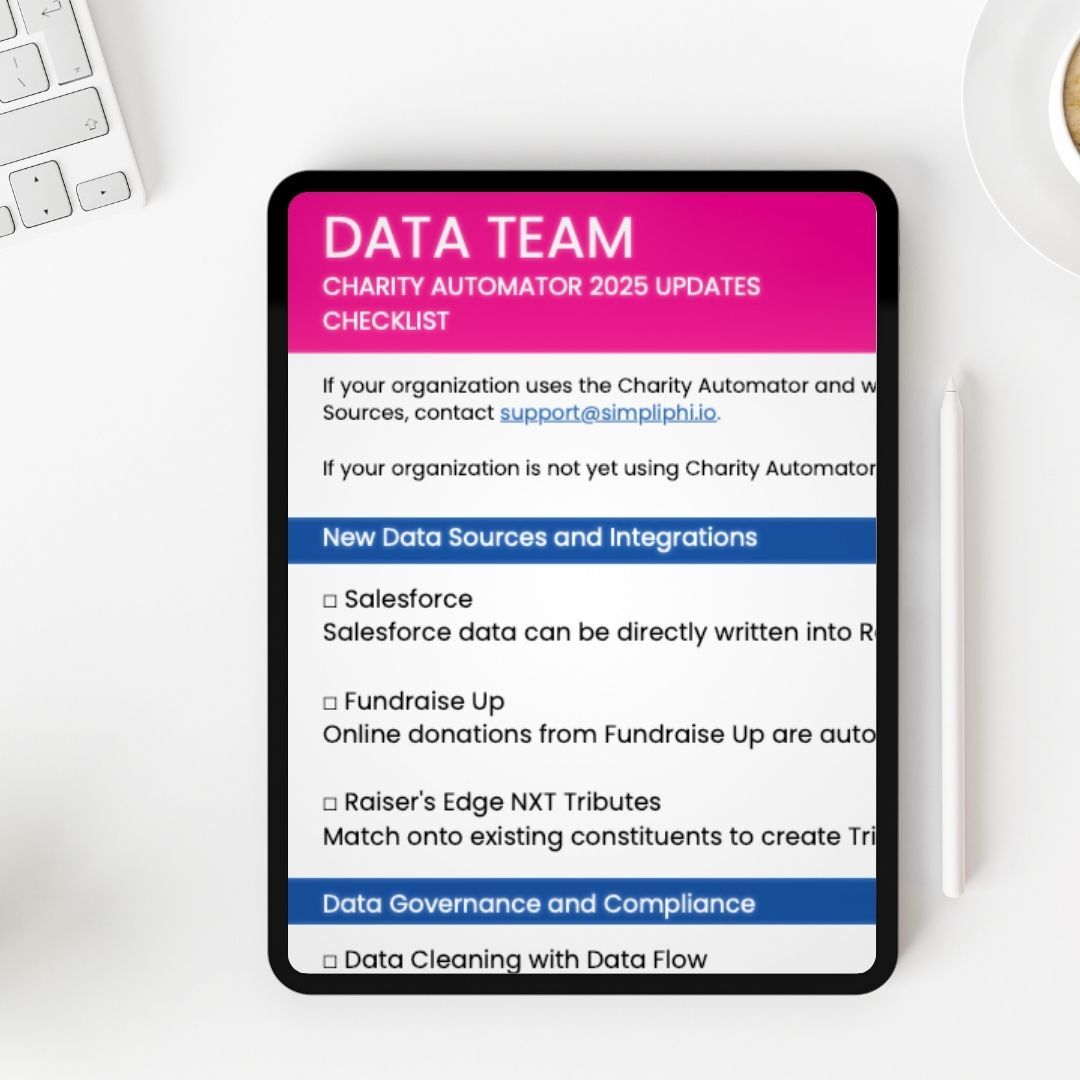
We created this checklist to help nonprofit data teams review recent Charity Automator Data Flow updates and confirm they are using all available...
3 min read
 Stefan Karnyaczki : Sep 10, 2026, 3:27:28 PM
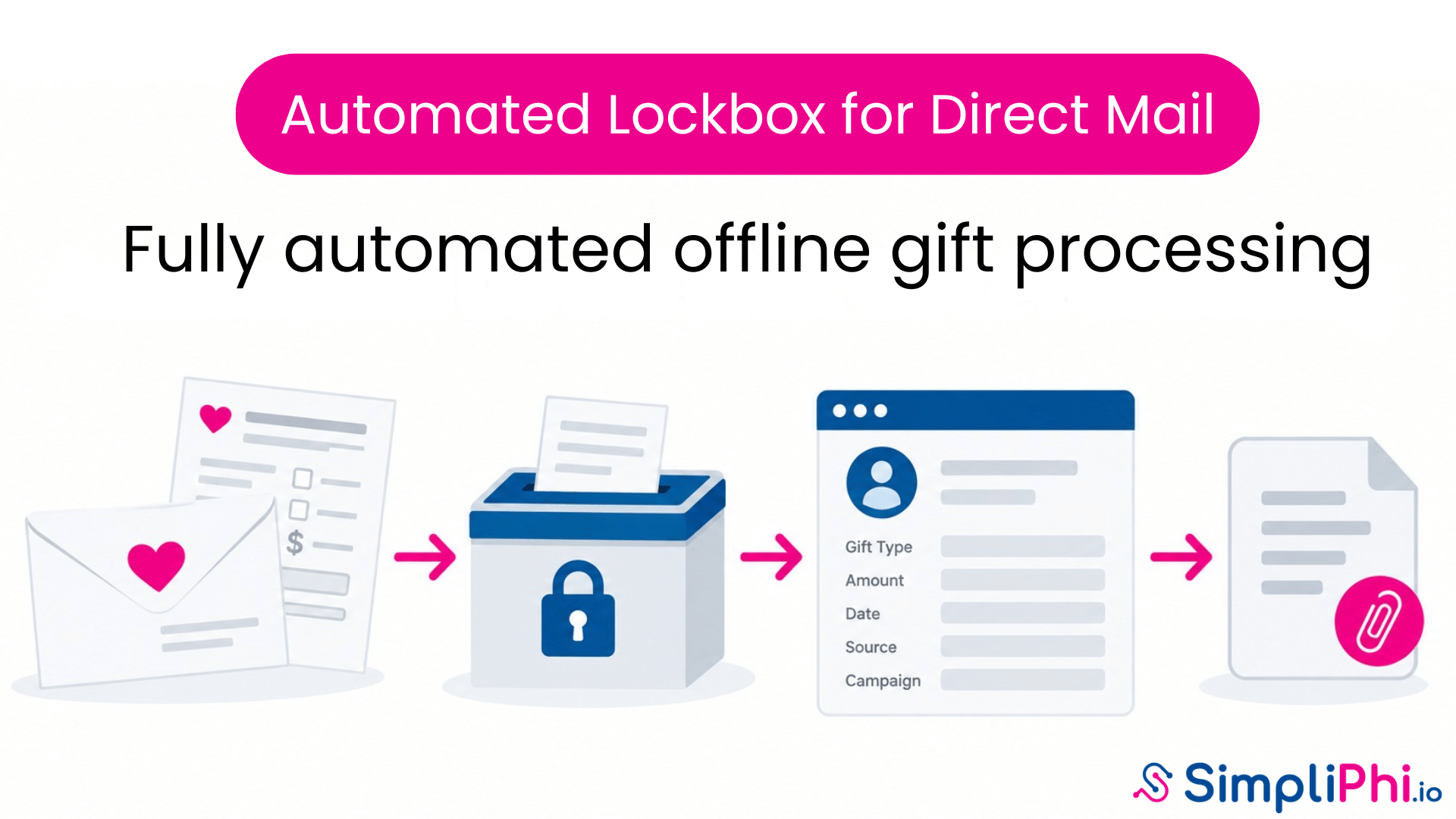
Automated direct mail gift processing connects returned mail, payment information, campaign coding and supporting documents with the correct...