First-Time Donor Segments for Hospital Foundations: A Practical Guide to Segmentation, Retention, and Revenue Growth
 Evgeniya Salomatina : May 8, 2026, 11:56:35 AM
How Hospital Foundations Can Improve Donor Retention Through Segmentation
Official Partner

We believe powerful tools shouldn't be complicated. SimpliPhi helps organizations work smarter, move faster, and drive real impact—simplifying the hard stuff so you can focus on what you do best.
Donor segmentation strategies for nonprofits can determine whether a campaign exceeds its goal or quietly underperforms.
For Communications and Annual Giving teams, segmentation directly shapes trust in the audience they are about to engage.
Right before a campaign launches, the real questions surface:
When segmentation lacks visibility, hesitation replaces momentum.
Below are practical, data-driven donor segmentation strategies nonprofit teams can use to build, validate, and activate audiences with confidence.

Donor segmentation is the process of dividing supporters into defined groups based on giving behavior, engagement history, and campaign activity.
Instead of sending one generic message to your entire database, segmentation allows nonprofits to:
Modern nonprofit donor segmentation focuses primarily on behavior, including:
The goal is simple: make sure each supporter receives communication that actually reflects their relationship with your organization.
Most nonprofits already use CRM segmentation strategies inside systems like Salesforce, Raiser’s Edge NXT or others. Access to data is rarely the issue for the organization. The real challenge lies in ensuring visibility and trust. Segmentation on CRM often relies on:
When teams cannot clearly see who is included (or excluded) in an audience, things start to stall. Someone double-checks the list. Someone else asks for a fresh report. The launch gets pushed while everyone tries to feel comfortable with the numbers. What should be a straightforward step turns into a pause filled with uncertainty.
RFM segmentation nonprofit models group donors by:
This model helps identify:
RFM segmentation remains one of the most effective donor segmentation strategies for nonprofits because it reflects actual giving behavior.
Behavioral segmentation outperforms demographic segmentation. Examples include:
When segmentation reflects how supporters actually engage, messaging becomes more relevant and response rates increase.
Retention-focused segmentation often delivers the highest ROI. Segment by:
Retention segmentation ensures loyal supporters are not overlooked and revenue leakage is minimized.
Major Giving and Sponsorship teams benefit from segmentation based on:
Clear audience definitions reduce reactive outreach and support strategic cultivation.
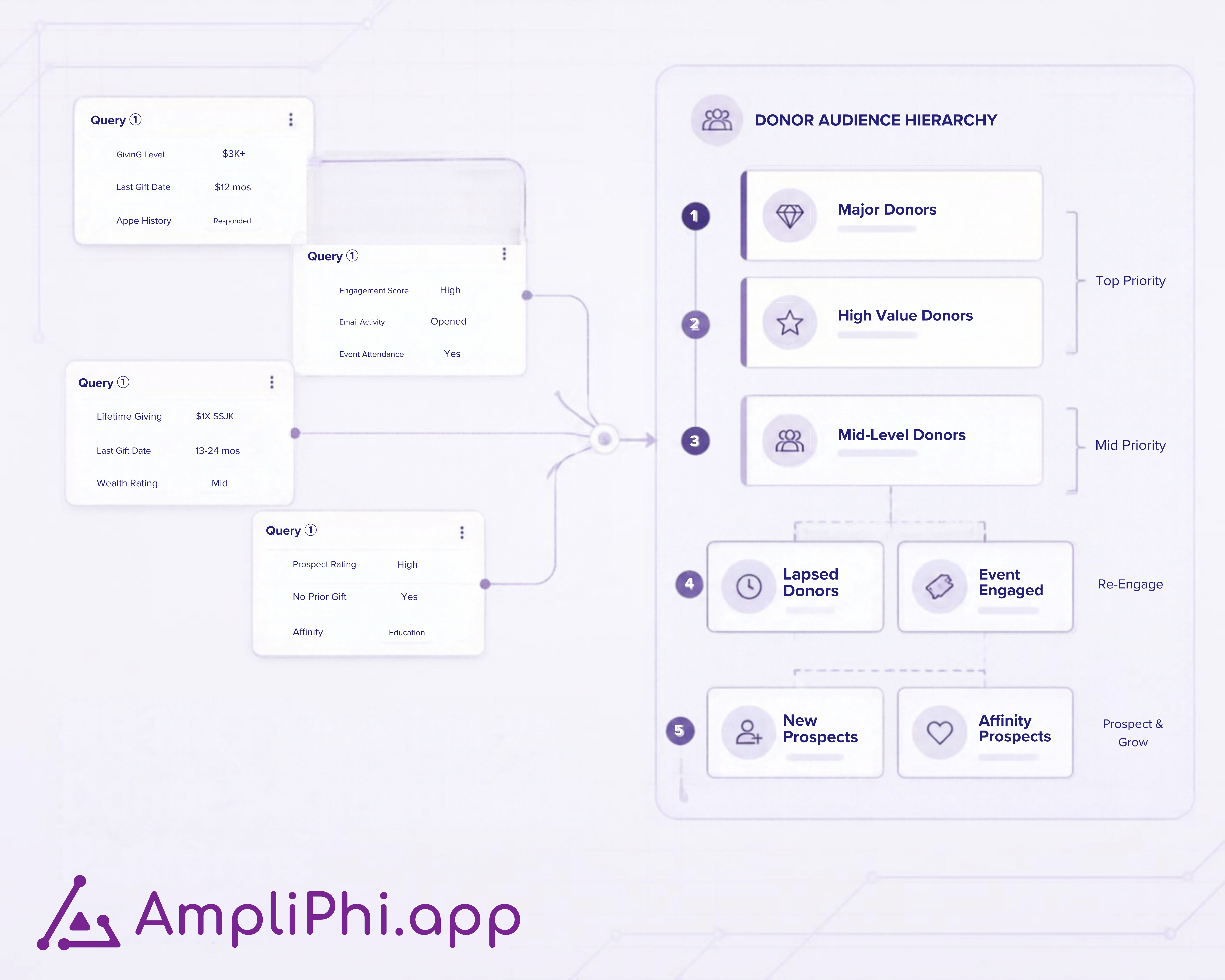
Donors often qualify for more than one segment at the same time: a recurring donor might also be a major donor, event participant, volunteer, or recent campaign responder.
Fundraising teams need to decide which segment should take priority when a donor qualifies for multiple audiences.
Ask:
A clear segment hierarchy establishes which audience takes precedence. This helps prevent duplicate or conflicting communications while keeping campaign treatment aligned with the donor's relationship with the organization.
Manual segmentation workflows create friction:
This hesitation has a revenue impact.
When audience selection lacks confidence:
Segmentation accuracy directly influences response rates, gift volume, and total campaign revenue.
Clarity drives confidence. Confidence drives performance.
Confident segmentation enables teams to:
When segmentation is transparent and validated, fundraising teams can operate more efficiently and with increased confidence. Fundraisers feel assured when sending communications, knowing that the messaging is more relevant to supporters. Campaigns are launched on schedule, and revenue outcomes become more predictable.
Effective nonprofit segmentation follows a structured workflow:
Connect - ensure CRM data is current and accessible.
Build - create audiences using clear, consistent criteria.
Validate - visually confirm who is included and review counts before activation.
Visualize - understand overlap, exclusions, audience gaps, and which segment takes priority when a donor qualifies for multiple audiences.
Activate - launch campaigns quickly, without waiting on manual verification
This structured approach eliminates hesitation and increases execution speed. For campaigns with overlapping audiences, define segment priority before activation so each donor has a clear campaign treatment and does not receive competing communications.
AmpliPhi is a nonprofit segmentation tool built specifically for fundraising teams who need visibility and validation before activating campaigns.
Instead of relying on spreadsheets or unclear CRM filters, AmpliPhi enables teams to:
At the core of AmpliPhi is a practical workflow: Connect. Build. Validate. Visualize. Activate.
Teams can build and adjust donor segments independently, confirm who is included, understand gaps across audiences, and activate campaigns in minutes instead of days.
The outcomes are tangible:
If your organization wants faster campaign execution, greater clarity into audience inclusion, less hesitation before launch, and stronger fundraising results, it may be time to rethink how segmentation is managed.
Ask for a demo of AmpliPhi and see exactly who is in your next campaign before you hit send.

Behaviour-based models such as RFM, retention segmentation, and recurring donor grouping consistently deliver strong fundraising performance.
Segmentation improves message relevance, fosters stronger relationships with donors, enhances fundraising results, and ensures more stable revenue.
By reviewing inclusion criteria, confirming audience counts in channels, and ensuring no key supporter group is excluded.
Lack of visibility into who is included (or excluded) in an audience and uncertainty before campaign activation.
When a donor qualifies for multiple segments, fundraising teams should establish a segment hierarchy that determines which audience takes priority. For example, a donor may simultaneously qualify as a recurring donor, major donor, event participant, and recent donor. Priority rules determine which segment ultimately governs the donor's campaign treatment, helping prevent duplicate or competing communications.
 Evgeniya Salomatina : May 8, 2026, 11:56:35 AM
How Hospital Foundations Can Improve Donor Retention Through Segmentation

 SimpliPhi : Jul 7, 2026, 10:51:08 AM
Download a practical donor segmentation guide for hospital foundations. Review acquisition sources, donor follow-up, and audiences before your next...
 Evgeniya Salomatina : Jul 28, 2026, 11:00:15 AM
Discover how to segment an annual giving campaign using lifecycle frameworks, RFM metrics, and multi-channel strategies to boost donor retention and...
 Evgeniya Salomatina : Sep 24, 2026, 5:14:06 PM
See how Raiser’s Edge NXT queries and a segmentation workspace work together, from source criteria to campaign rules, count validation, and CRM...
 SimpliPhi : Jul 2, 2026, 2:53:05 PM
AmpliPhi helps nonprofit and hospital foundation teams prioritize, validate, and apply campaign audiences alongside Raiser’s Edge NXT or Salesforce.

 Somkala Pachhai : Feb 25, 2026, 2:12:46 PM
AmpliPhi is an audience segmentation and donor segmentation tool for nonprofits. Learn how we use client feedback to improve audience validation,...
 Evgeniya Salomatina : Apr 14, 2026, 3:07:25 PM
Why do donors who give the same amount behave differently? Learn how donor affinity impacts segmentation, retention, and fundraising performance.
 Evgeniya Salomatina : Aug 26, 2026, 2:41:50 PM
Compare 7 donor segmentation tools for nonprofits in 2026. See CRM connectivity, audience priority, validation, multichannel planning, AI, and best...