SegmentOmatic vs. AmpliPhi: A Leadership Guide to Donor Segmentation
Compare SegmentOmatic and AmpliPhi through one foundation’s workflow: overlapping donor audiences, slow calculations, barcode exports, and campaign...
Official Partner
We believe powerful tools shouldn't be complicated. SimpliPhi helps organizations work smarter, move faster, and drive real impact—simplifying the hard stuff so you can focus on what you do best.
13 min read
Evgeniya Salomatina
:
Published
Updated
The best donor segmentation tools for nonprofits help fundraising teams build, prioritize, validate, and use donor audiences for campaigns. Depending on the platform, that may include CRM-connected data, inclusion and exclusion rules, audience hierarchy, overlap validation, multichannel planning, AI-assisted segmentation, and campaign execution.
This guide compares seven donor segmentation tools built for nonprofit fundraising campaigns: AmpliPhi, Avid AI, Bloomerang, Virtuous, Salesforce Nonprofit Cloud, Bonterra EveryAction, and Blackbaud Raiser’s Edge NXT. We compared them based on segmentation logic, audience hierarchy, CRM data access, AI-assisted audience building, multichannel readiness, validation, and campaign execution.
The first decision is whether you need a new fundraising CRM or a dedicated way to prepare campaign audiences using the CRM you already have.
For RE NXT teams with recurring direct-mail and email appeals: See an RE NXT campaign-audience workflow in AmpliPhi, including exclusions, segment priorities, count validation, and CRM assignments.
SimpliPhi is the company behind AmpliPhi. We evaluated each platform using the campaign-segmentation criteria described below and publicly available product information. Product functionality can change, so organizations should confirm current functionality.
You deserve tools that match the way your fundraising team actually works, not platforms that force you to wait on IT or export to spreadsheets before every campaign. We evaluated these seven platforms based on criteria that matter to development operations teams running multichannel appeals on tight timelines.
AmpliPhi is a donor segmentation platform for nonprofit fundraising teams that need to build, prioritize, validate, and apply campaign audiences using live CRM data. It connects directly to Raiser’s Edge NXT or Salesforce and provides a shared workspace for managing campaign segmentation.
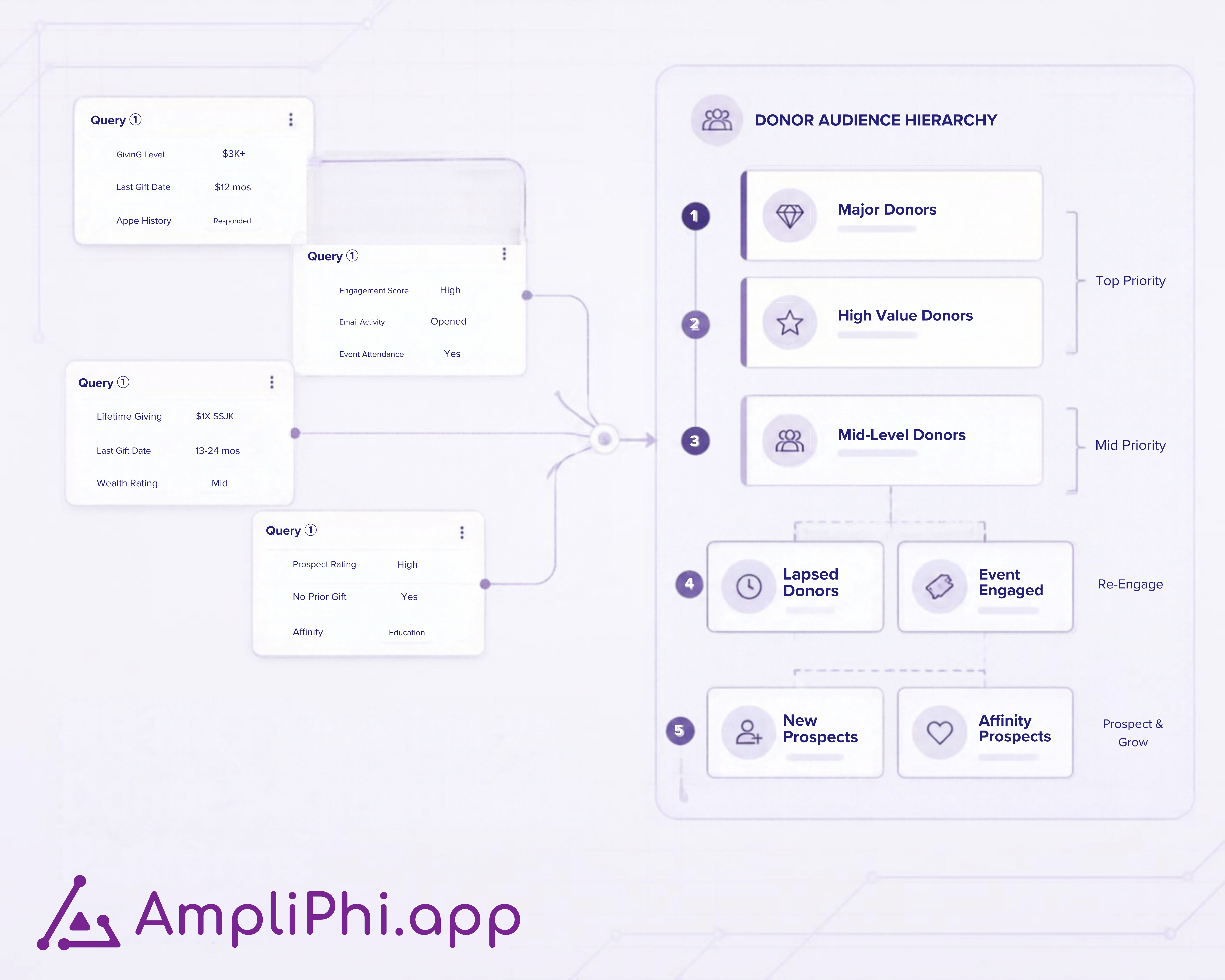
Unlike a CRM query that identifies records matching a set of conditions, AmpliPhi manages the relationship between multiple campaign audiences. Teams can define inclusions and exclusions, establish processing priority, validate audience counts and overlap, apply communication-channel rules, and push approved segmentation details back to the CRM.
The Fundraising Effectiveness Project estimated that overall donor retention was 42.9% in 2024. New-donor retention was only 19.4%, compared with 69.2% for repeat donors. These figures demonstrate why recognizing donor history and lifecycle stage matters when building campaign audiences.
SimpliPhi built AmpliPhi to put segmentation control back in the hands of fundraisers. Your team sees validated audience counts before campaigns launch, can undo mistakes instantly, and pushes final segmentation detail back to your CRM without manual exports.
Pros:
Cons:
Preparing a hospital foundation campaign? Download our hospital foundation segmentation guide to review acquisition sources, second-gift follow-up, and campaign audiences with your team.
Avid is an AI-powered fundraising platform that connects data from CRMs, email platforms, advertising tools, online giving systems, and other sources. Its Pathways functionality allows fundraising teams to create dynamic donor audiences and keep them synchronized as donor data and behaviour change.
Teams can build audiences manually or describe the audience they need in plain language. Avid AI then suggests audience filters, a name, and a potential value proposition. Users can review and edit the suggested definition before deploying the audience to a connected platform or exporting it as a CSV.
Avid is broader than a dedicated segmentation platform. In addition to audience building, it provides fundraising insights, benchmarks, playbooks, campaign recommendations, and direct-mail functionality. This makes it suitable for organizations looking for an AI-supported fundraising operating system rather than a tool focused specifically on campaign segmentation hierarchies.
Pros:
Cons:
Bloomerang includes a built-in engagement score that tracks donor interactions across email opens, event attendance, and giving frequency.
The CRM's segmentation is filter-based, so you select criteria like giving range, last gift date, or communication preferences to build lists. These lists can be exported for use in email or mail campaigns.
Pros:
Cons:
Virtuous CRM includes automation workflows that trigger actions based on donor signals like giving milestones, lapsed periods, or engagement changes. Segments in Virtuous are built through a query interface that allows and/or logic on contact fields and giving history.
The platform connects to email tools and supports multichannel outreach, though segment activation still requires setup across separate modules for each channel.
Pros:
Cons:
Salesforce Nonprofit Cloud offers reports, dashboards, and segmentation through its standard reporting engine and campaign management module. Organizations with a trained Salesforce administrator can build custom segments using any field in the database.
The platform's strength is its configurability. With AppExchange apps and custom objects, Salesforce can handle complex segmentation logic. That configurability comes with administrative overhead, however, which means fundraising staff rarely build segments without technical support.
Pros:
Cons:
Bonterra EveryAction is a nonprofit CRM and engagement platform that combines donor management, fundraising, email, mobile messaging, advocacy, reporting, and campaign workflows. Its Create a List functionality allows teams to build and save supporter audiences using criteria stored in EveryAction.
EveryAction also includes Bonterra Que, an AI-powered fundraising assistant. Users can describe the donors they want to reach in plain language, and Que creates a proposed segment using giving behavior, engagement history, and supporter interests. Teams can review the logic, refine the criteria, save the segment, and use it across EveryAction’s communication channels.
Unlike AmpliPhi, which adds a dedicated segmentation workspace to an existing Raiser’s Edge NXT or Salesforce environment, EveryAction provides segmentation as part of a broader CRM, fundraising, and engagement platform.
Pros:
Cons:
Raiser's Edge NXT includes a query module that allows development teams to select donors using criteria like gift amount, fund, campaign, and constituent attributes. For organizations already in the Blackbaud ecosystem, queries connect to exports and batch processing for campaign execution.
Raiser’s Edge NXT supports static and dynamic queries, Lists built from eligible queries, and Managed Lists for curated inclusion and exclusion decisions. These native features may be sufficient for many constituent-selection workflows. Teams should compare the complete campaign process, including overlap resolution, segment processing priority, channel-specific preparation, and approved CRM assignments, before deciding whether an additional workspace is useful.
Pros:
Cons:
| Platform | Product type | Hierarchy and prioritization | Connected data | Channel preparation or deployment | AI-assisted audiences | Best fit |
|---|---|---|---|---|---|---|
| AmpliPhi | Dedicated segmentation platform | Yes | Direct CRM connection | Prepares and pushes segmentation data | No | Fundraiser-controlled campaign segmentation |
| Avid AI | AI fundraising platform | Different audience model | Connected fundraising stack | Synchronizes audiences to connected platforms | Yes | AI-assisted audiences and campaign recommendations |
| Bloomerang | Nonprofit CRM | Filter-based audiences | Native CRM data | CRM and connected tools | Yes, conversational reporting | Smaller teams using Bloomerang |
| Virtuous | Responsive fundraising CRM | Query and workflow based | Native CRM data | Built-in and connected workflows | Confirm exact functionality | Mid-sized responsive fundraising teams |
| Salesforce Nonprofit Cloud | Configurable nonprofit CRM | Custom configuration | Native Salesforce data | Requires Salesforce tools or integrations | Depends on configuration | Teams with Salesforce expertise |
| Bonterra EveryAction | Fundraising CRM/platform | List-based | Native platform data | Platform-dependent | Confirm exact functionality | Teams using EveryAction |
| Raiser’s Edge NXT | Fundraising CRM | Query, Lists, and Managed Lists | Native CRM data | Exports and Blackbaud tools | Confirm exact functionality | Organizations already using Blackbaud |
Relevant communication based on giving history and engagement can support stronger donor relationships and retention. According to the Fundraising Effectiveness Project, new-donor retention was 19.4% in 2024, meaning approximately one in five new donors gave again the following year.
Segmentation can help address that challenge by matching communication to donor context. A first-time giver who responded to a peer-to-peer campaign needs a different follow-up than a multi-year mid-level donor approaching a major gift ask.
When your segmentation strategy accounts for giving level, recency, channel preference, and campaign history, you create the conditions for retention to improve. The difference between a donor who feels seen and one who receives irrelevant outreach is often just one well-timed, well-targeted message.
Start with how your team actually runs campaigns. If you rely on a data specialist to pull lists, a tool that puts segmentation directly in fundraisers' hands removes a bottleneck and shortens your time to launch.
Consider whether you need hierarchy and prioritization. Campaigns that span multiple channels and multiple asks require logic to prevent donors from receiving conflicting messages. A tool with built-in prioritization handles that automatically, while a flat query tool leaves you managing conflicts in spreadsheets.
Look for real-time data connections. Static list exports go stale quickly, especially during active campaigns when donor records are changing. A platform that validates audiences against live CRM data gives you confidence that your counts are accurate at the moment of send.
AmpliPhi was built to give nonprofit fundraising teams the ability to build, validate, and prepare donor segments for campaign execution without waiting on IT, exporting to spreadsheets, or losing control of campaign targeting.
Native CRM Query and Lists features can address many selection tasks. AmpliPhi is worth evaluating when teams need to organize several overlapping audiences into one campaign, establish processing priorities, apply channel rules, review counts, and prepare repeatable CRM assignments. Whether this additional workflow is valuable depends on the campaign’s complexity and the capabilities already configured in the CRM.
SimpliPhi designed AmpliPhi to connect directly to your source systems, so your audiences are always current. You see validated counts, preview overlap, and push segmentation detail back to your CRM in one step. No more stale lists. No more manual reconciliation between what you planned and what actually sent.
If your mission needs personalized, timely outreach that matches each donor's relationship with your organization, AmpliPhi can help you move from idea to campaign in one sitting.
Donor segmentation is the practice of dividing your donor file into distinct groups based on giving behavior, engagement level, and communication preferences. AmpliPhi makes this process faster by letting you build and validate segments directly from your CRM data.
Segmented outreach means donors receive messages that match their relationship with your organization, which leads to stronger retention and higher lifetime value.
AmpliPhi focuses on fundraiser-controlled campaign segmentation, including parent-and-child hierarchies, inclusion and exclusion rules, processing priority, catch-all groups, channel planning, audience validation, and pushing finalized segmentation data to the CRM. Avid AI takes a broader AI-assisted fundraising approach, generating dynamic audiences, identifying campaign opportunities, and synchronizing audiences with connected engagement platforms.
AmpliPhi adds segmentation hierarchy, inclusion and exclusion rules, donor-first channel planning, and campaign execution readiness on top of your existing CRM data. CRM-native tools typically produce flat query results without prioritization logic.
With AmpliPhi, teams manage segment priority, exclusions, and communication-channel rules together, then prepare assignments for the existing CRM. Compare this with the latest native Query, Lists, and Managed Lists functionality before purchasing an additional platform.
Yes. Even organizations with fewer than 5,000 donors run campaigns across multiple channels. AmpliPhi helps you avoid sending conflicting messages, validate your audience counts, and launch personalized campaigns faster than manual list exports allow.
AmpliPhi connects to Raiser's Edge NXT and Salesforce as primary source systems. SimpliPhi continues to expand integration options based on the nonprofit sector's most-used platforms. You can check current availability on the AmpliPhi website.
AmpliPhi's onboarding is designed to get you building segments in your first session. Connect your CRM, select a template from the gallery, and customize your audience hierarchy. SimpliPhi's team supports you through setup with guided onboarding and in-app chat.
Raiser’s Edge NXT queries can identify constituents that meet defined criteria and are useful for many fundraising workflows. A dedicated donor segmentation platform adds another layer for campaigns that involve multiple overlapping audiences, processing priority, inclusions and exclusions, validation, communication-channel rules, and applying final segmentation decisions back to the CRM.
Compare SegmentOmatic and AmpliPhi through one foundation’s workflow: overlapping donor audiences, slow calculations, barcode exports, and campaign...
AmpliPhi helps nonprofit and hospital foundation teams prioritize, validate, and apply campaign audiences alongside Raiser’s Edge NXT or Salesforce.
Download a practical donor segmentation guide for hospital foundations. Review acquisition sources, donor follow-up, and audiences before your next...
How Nonprofits Can Personalize Donor Outreach and Boost Engagement with Smarter Segmentation.
See how Raiser’s Edge NXT queries and a segmentation workspace work together, from source criteria to campaign rules, count validation, and CRM...
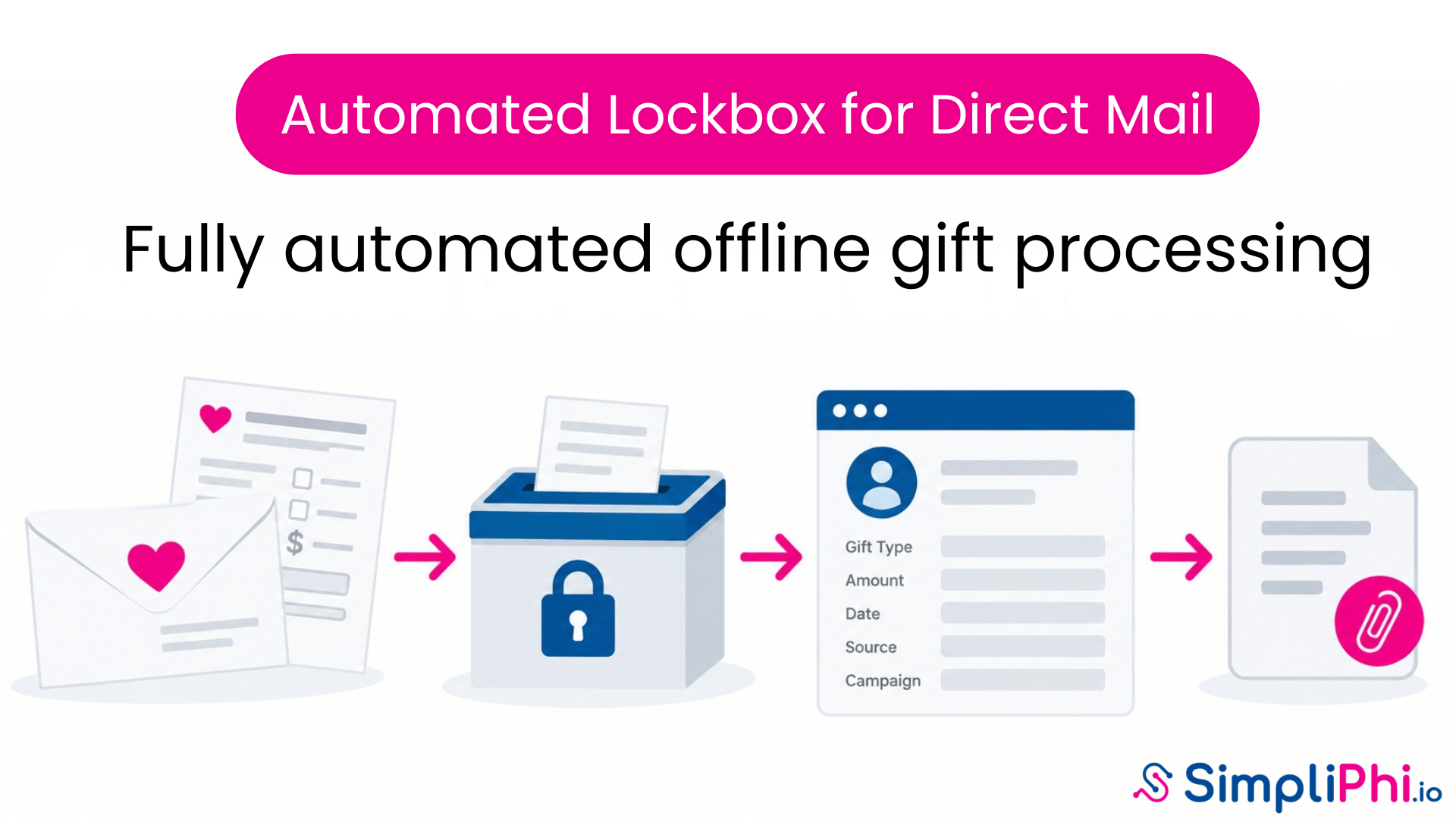
Learn how nonprofits can automate direct mail gift processing from lockbox receipt through Raiser’s Edge NXT gift creation and document management.
Define who approves donor exclusions in hospital foundation campaigns, what to record, and how to handle late changes across email and direct mail.
Nonprofit teams live inside a thousand small deadlines. A campaign segment finishes building, a template-generated campaign is ready, an invoice is...