1 min read
Annual Giving Campaign Checklist: 10 Questions to Answer Before Launch
 SimpliPhi : Aug 10, 2026, 12:31:39 PM
Official Partner

We believe powerful tools shouldn't be complicated. SimpliPhi helps organizations work smarter, move faster, and drive real impact—simplifying the hard stuff so you can focus on what you do best.
Annual giving campaigns are under more pressure than ever before. Donors are inundated with messages, attention spans are shrinking, and expectations for relevance and personalization continue to rise. At the same time, many organizations are still relying on outdated, one-size-fits-all campaign strategies that treat their entire donor base as a single audience.
The result? Declining response rates, stagnant retention, and missed opportunities for growth.
Segmentation is the solution. At its core, segmentation is a strategic shift in how organizations think about their donors. Instead of asking, “What message should we send?” segmentation asks, “Who are we talking to, and what is their relationship with us?”
This guide provides a practical framework for segmenting your annual giving campaign. It synthesizes proven strategies from modern fundraising practice and translates them into actionable steps you can implement immediately. Whether you are leading a large advancement team or managing a small nonprofit program, this guide will help you build a segmentation strategy that increases engagement, improves retention, and drives sustainable revenue growth.
The majority of underperforming annual giving campaigns share a common flaw: they rely on generic, mass communication. In a crowded fundraising landscape, broad messaging functions as background noise. When an organization sends a uniform appeal to its entire database, it ignores the unique history, motivations, and engagement levels of its distinct donor groups.
Irrelevance is not just neutral, it carries a direct financial penalty. When donors receive communications that fail to reflect their specific relationship context, their connection to the mission degrades. This strategic mismatch leads directly to the core operational challenges facing modern development departments:
| Issue | Operational Impact | Strategic Consequence |
| One-Size-Fits-All Messaging |
The same appeal letter or email blast is sent to multi-year donors, brand-new event attendees, and lapsed supporters alike. |
Donors feel misunderstood and fundamentally disconnected from the organization, driving down affinity. |
| Lack of Audience Prioritization |
Production resources and writing hours are distributed equally across all records, regardless of conversion probability. |
Staff capacity is exhausted on low-yield segments while high-value donor retention receives insufficient focus. |
| Channel-First Execution |
Campaigns are planned around channel deployment schedules (e.g., "the October mail piece") rather than audience needs. |
Internal communication teams become heavily siloed, and the donor experiences a fragmented, inconsistent relationship. |
| Neglect of Behavioral Data |
Segmentation logic relies strictly on basic biographical data or arbitrary, outdated parameters. |
Highly predictive giving behaviors, historical motivations, and transactional patterns are ignored. |
The takeaway for advancement leadership is clear: donors do not respond to generic campaigns; they respond to relevance. True personalization is the only systematic way to cut through the surrounding clutter and stabilize long-term revenue growth.
Modern fundraising operates entirely within an attention economy. Nonprofits are actively competing against major consumer brands, streaming entertainment platforms, social media environments, and the daily flood of digital noise for a finite amount of human focus.
The volume of messages directed at the average consumer has reached an unprecedented peak. Within the nonprofit sector alone, messaging density continues to scale rapidly:
This massive influx of information has fundamentally altered human behavior. Donors are consumers who interact daily with commercial ecosystems designed entirely around hyper-personalization. Platforms like Amazon, Netflix, and Spotify have established an experiential standard where content, product recommendations, and relationship touchpoints are dynamically tailored to the individual's exact historical usage.
This behavioral expectation carries over completely into philanthropy. Donors do not lower their structural standards for data relevance when interacting with a nonprofit organization.
Quantitative consumer research confirms that 72% of modern consumers engage exclusively with marketing communications that are explicitly tailored to their specific, verified interests.
Failing to personalize communication has a measurable cost in lost donor lifetime value. According to standardized giving effectiveness data, 53% of donors who discontinue their financial support do so explicitly because the nonprofit fails to communicate an authentic understanding of who they are and why they are connected to the cause.
This means that more than half of donor attrition is driven by an operational failure to deliver relevant communication. Personalization is a core revenue preservation strategy.
A fundamental error in annual giving campaign architecture is the traditional focus on theme and creative copy before defining the audience. When a team starts by establishing a centralized campaign concept, such as writing an elaborate winter appeal letter or creating a specific digital graphic package, and then searches for datasets to match that concept, they are executing a channel-driven strategy.
Effective, modern annual fund management reverses this sequence entirely by employing an audience-first model.
| Phase | Traditional, Channel-First Paradigm | Modern, Audience-First Paradigm |
| Campaign Conception | The team develops a single, centralized campaign theme, creative look, and core copy package. |
The database team audits the active file to isolate clear donor segments based on relationship lifecycle and behavior. |
| Message Formulation | A singular master message is written, with minor copy changes made to adapt it for different channels. |
Unique, tailored copy parameters are established for each distinct segment based on their historical giving motivations. |
| Audience Assignment | The list is pulled as a massive pool, and data is pushed uniformly into the predetermined creative framework. |
Data segments are prioritized via a strict hierarchy to prevent overlap and ensure clean list execution. |
| Operational Priority | Success is evaluated based on completing channel goals (e.g., getting the direct mail out the door on time). |
Success is evaluated based on metrics like segment retention, average gift growth, and strategic upgrade paths. |
By forcing audience definition to the absolute front of your campaign development pipeline, you gain a critical advantage: you ensure that every written sentence explicitly targets the documented psychology of the recipient. The strategic objective shifts from convincing a generic crowd to give, to honoring an established, individual relationship context across every active communication touchpoint.
The absolute core of strategic segmentation is the systematic evaluation of relationship context. Every interaction your organization has with a constituent must explicitly reflect the exact stage, historical trajectory, and unique motivation of that specific connection.
To understand how relationship context fundamentally transforms communication, consider the psychological impact of identical messaging delivered across different relationship boundaries:
Scenario A: "Happy birthday, all the best." — Jane from Accounting
Scenario B: "Happy birthday, all the best." — Mom
The words employed in both scenarios are identical. However, the feeling generated by the communication is completely different. In Scenario A, the messaging feels professional, structured, and entirely appropriate. In Scenario B, the exact same words feel cold, detached, and potentially damaging to the relationship .
Now reverse the emotional framework:
Scenario C: "Happy birthday, I love you more than words can say!" — Jane from Accounting
Scenario D: "Happy birthday, I love you more than words can say!" — Mom
In Scenario D, the communication is perfect, validating, and deepens the bond . In Scenario C, it creates a massive boundary violation that instantly damages the connection . The relationship context completely dictates the reception of the message .
In annual giving fundraising, sending a generic blast appeal to a multi-year consecutive donor that reads like a basic informational request is the operational equivalent of sending your mother the birthday note from Jane in Accounting . It shatters the illusion of an authentic relationship, signals that you view them as an entry in a database rather than a true partner, and directly causes donor fatigue and attrition. Your data structures must be built to recognize, preserve, and speak to this context at scale.
To turn relationship context into a practical database strategy, you need a multi-dimensional framework. Relying solely on basic data variables (such as a donor's total lifetime contribution or geographic location) provides an incomplete picture. Instead, high-performing annual giving segmentation relies on four core analytical dimensions:
| Dimension | Operational Phase | Target Data Points |
| 1. Lifecycle Stage |
Establishes the baseline foundation of your entire segmentation strategy. |
Tracks the clear progression of a constituent from an unacquired prospect to a first-time donor, a multi-year repeat supporter, a lapsed file record, and a reactivated partner. |
| 2. RFM Metrics |
Measures explicit engagement and transactional recency within the database. |
Recency: Months since the last transaction . Frequency: Total distinct transaction records . Monetary: Specific dollar value or cumulative annual value of contributions. |
| 3. Behavioral Context |
Tracks the explicit entry pathway or historical motivation of the donor. |
Categorizes records based on whether they arrived via peer-to-peer campaigns, tribute/in-memory gifts, upscale special events, or direct service delivery programs . |
| 4. Channel Preference |
Optimizes campaign delivery formats to maximize conversion and reduce waste. |
Maps how the donor actively interacts with your communications across direct mail, email, SMS, and telemarketing channels. |
When running an annual giving campaign, a common database challenge is that a single donor record can easily qualify for multiple segments simultaneously. For instance, a monthly donor might also be a grateful patient, a recurring event attendee, and a historical major donor.
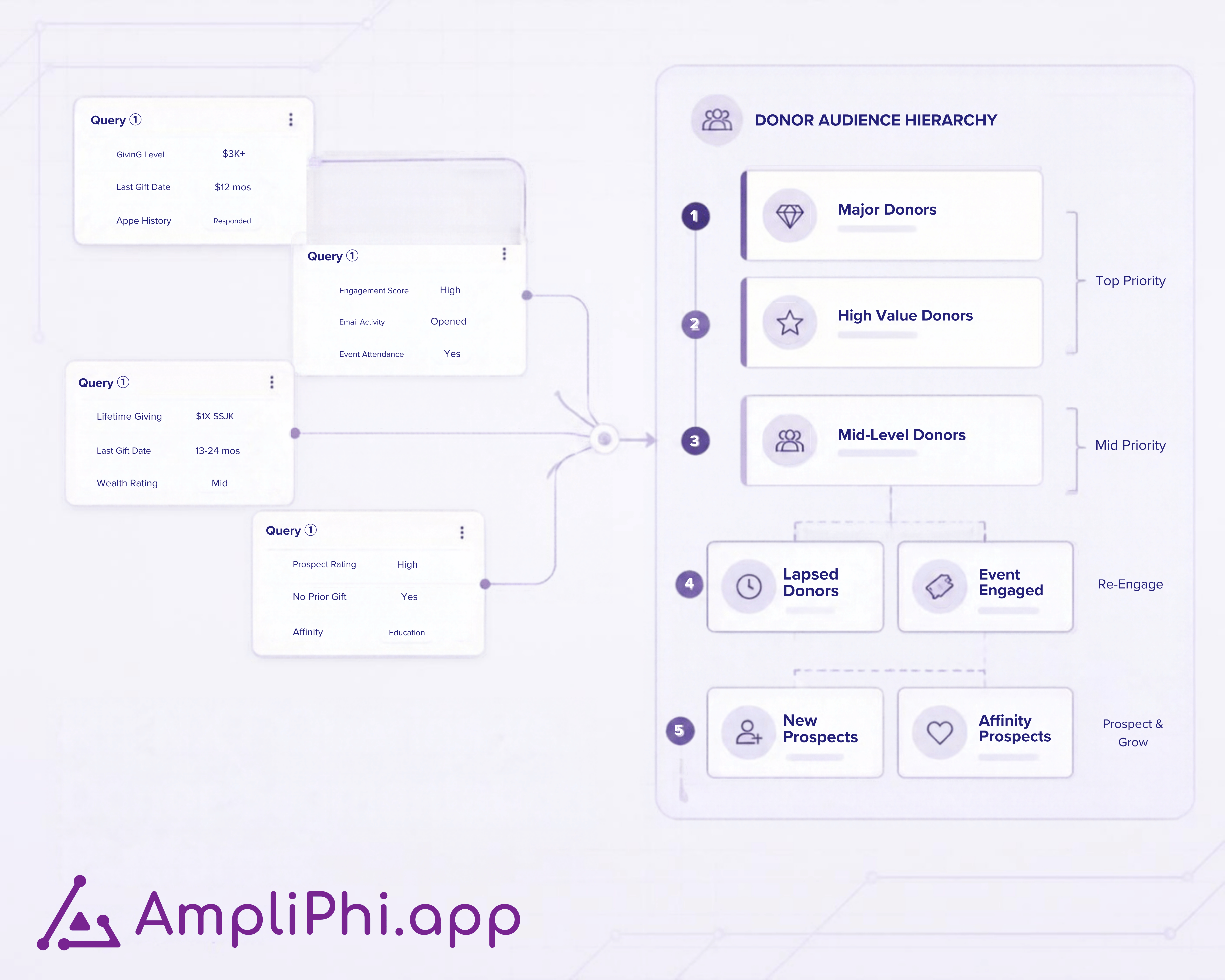
To prevent data confusion, overlapping appeals, and duplicate communications, you must establish a strict donor hierarchy before building a single query.
A donor hierarchy functions as an operational sorting logic. Your data selection criteria must run sequentially from highest priority to lowest priority. Once a donor matches the criteria for a high-priority segment, they land in that audience and are automatically excluded from being pulled into any lower-priority pools.
| Priority Level | Target Donor Segment | Core Strategic Focus & Action |
| 01 | Major Donors |
Personalized leadership and stewardship track; pulled first for customized handling. |
| 02 | Mid-Level Donors |
High-touch renewal track; focus on tailored strategic upgrade paths. |
| 03 | Monthly / Recurring Donors |
Sustainer retention track; exclude from generic year-end cash asks to prevent disruption. |
| 04 | New / First-Time Donors |
Highest baseline priority for broad appeals; focus entirely on second-gift cultivation. |
| 05 | Active Annual Retained Donors |
Multi-year repeat givers; standard renewal and consistent impact-reporting track. |
| 06 | Recaptured Retained Donors |
Recently reactivated records; focus on loyalty fortification and habits. |
| 07 | Lapsed Donors |
Inactive for 24+ months; lowest priority track focused on targeted reactivation triage. |
New donor acquisition represents a significant financial investment for any advancement operation. On average, first-time donors make up approximately 38% of a typical nonprofit's annual donor file, making them the second-largest overall segment in the database. Yet, standard industry data reveals a painful trend: only about 14% of these new acquisitions will ever make a second gift.
This dismal 86% attrition rate creates a massive "leaky bucket" problem. When you consider that it costs roughly 10 times more to find and acquire a brand-new donor than it does to maintain a relationship with an existing one, letting almost nine out of ten new donors walk out the door after a single gift is a massive financial drain on your budget.
However, if you can successfully guide a first-time donor to make that critical second gift, the data changes dramatically: their retention probability immediately jumps to 47%, and they transform into the single largest long-term segment on your donor file . Your entire first-year stewardship strategy must be built entirely around securing that second gift.
This high first-year attrition rate is primarily driven by the Affinity Gap. The affinity gap is the strategic disconnect between a donor's initial motivation to give and their long-term connection to your broader mission .
Most first-time donors do not give because they are deeply invested in your organization's multi-year strategic plan. In fact, they frequently aren't giving to your organization at all—they are giving to a friend, honoring a loved one, or buying an experiential ticket . Because their entry point is highly situational, treating them like a standard, mission-driven repeat donor causes relevance to plummet and retention to weaken.
To execute effective personalized outreach, you must segment your first-time acquisitions into clear, motivation-based affinity tiers from day one:
| Affinity Level | Target Database Segments | Psychological Profile of the Giver | Core Operational Strategy |
| Low Affinity |
• Peer-to-Peer (P2P) Supporters • Tribute & In-Memory Donors |
The donor is connected entirely to an individual supporter or a deceased loved one, completely bypassing your mission. |
Redirection: Celebrate the personal relationship that prompted the gift while clearly showing how that action enabled impact. |
| Medium Affinity |
• Event Participants • Grateful Patients / Service Recipients |
The giver is motivated by a distinct personal experience, upscale activity, or direct care received. |
Mission Shifting: Connect their positive personal experience to the critical funding needed to scale that work for others. |
| High Affinity |
• Direct Digital Advertising Converts • Mission-Driven Appeal Responders |
The donor responded directly to your core message, is highly motivated by the cause, and consciously wants to advance it. |
Rapid Loyalty Cultivation: Prime candidates for immediate monthly/recurring giving invitations. |
Many nonprofits default to a strict "do not contact" policy for peer-to-peer donors. This choice is driven by a common fear that reaching out directly will alienate the donor or frustrate the active participant who brought them in.
This is a major missed opportunity. The data reveals that communicating thoughtfully with P2P donors is highly effective for building long-term, direct relationships, which becomes incredibly valuable if that original participant steps away or stops fundraising in future years. The goal isn't to keep them trapped as passive P2P donors forever; it’s to systematically convert them into direct, lifelong mission advocates.
| Phase | Strategy Title | Tactical Copy Focus |
| Step 01 | Celebrate the Friend |
Honor the personal relationship that triggered the initial gift. Example: "Thank you for supporting Sarah's personal fundraising challenge for our research team." |
| Step 02 | Reveal the Broader Impact |
Explicitly show how that specific transaction directly enabled a larger, tangible programmatic outcome. Example: "Because of the funding raised by you and Sarah, our community clinic expanded its care hours." |
| Step 03 | Invite Direct Conversion |
Pivot the conversation to present a direct, independent case for supporting the core mission. Example: "Will you join us directly this season to keep these vital clinic hours funded?" |
A standard industry myth dictates that brand-new in-memory or tribute donors should simply be dropped into your regular 5-year annual giving renewal appeal cycle and treated just like any other active supporter .
This is an expensive mistake. The stark reality is that the vast majority of in-memory givers are performing a one-time social duty. They are paying their respects to a family member or friend, and a large portion of them will never develop a true affinity for your broader cause, no matter how many generic appeal letters you send .
The optimal strategy requires an intentional time boundary:
The 12-to-18-Month Operational Threshold: Focus your first-year cultivation pieces entirely on bridging the affinity gap. Run a targeted sequence of impact updates and gentle invitations to engage with the mission. If an in-memory donor does not convert by making a second, mission-driven gift within that 12-to-18-month window, you must systematically drop them from your active annual appeal lists. Continuing to mail them beyond this threshold burns processing capacity, skews your response data, and lowers your programmatic return on investment.
Repeat retained donors—those who have made at least two distinct contributions and continue to give year after year—represent the financial engine of your fundraising operation. While they typically make up roughly 40% of an organization's overall donor database, they account for over 60% of the total dollars raised annually.
The retention physics for this segment are incredibly reliable: nearly half (43%) of repeat donors will give again this year, compared to that fragile 14% retention rate for first-time givers. Furthermore, maintaining a relationship with a repeat donor is highly cost-effective, costing just a small fraction of the budget required to go out and secure a brand-new constituent.
Repeat donors are highly committed, but they are not all equal. To maximize their lifetime value, you must segment them by giving capacity and approach rather than sending a uniform renewal ask across the board :
Recaptured donors are constituents who previously allowed their financial support to lapse for 24 months or more, but have been successfully reactivated back onto the active donor file. On average, reactivated donors make up about 13% of an organization's overall donor file.
Securing this reactivation is a tough battle: the typical industry-wide recapture rate on a lapsed database file hovers at a tight 2%. This means that for every 100 historical lapsed records sitting in your system, only two will respond to standard reactivation outreach.
However, pursuing this segment is a smart strategic choice. Reactivating an established lapsed donor who already knows your organization costs roughly half of what it takes to launch cold acquisition campaigns to find a completely new supporter.
Because the baseline reactivation rate is a tight 2%, sending broad, unsegmented direct mail packages to your entire multi-year lapsed database is a recipe for high marketing costs and low returns. You need to employ a strict triage framework to identify exactly which lapsed records are worth a financial investment:
Always audit how the donor originally arrived on your file. If their first and only contribution was a highly situational gift—such as supporting a friend's one-time peer-to-peer challenge or an isolated in-memory tribute—a generic, mission-focused reactivation appeal will almost certainly fail . Focus your budget on records whose historical giving was driven by direct, mission-centered appeals.
Constituents who demonstrated deep, long-term commitment to your organization before lapsing are far more likely to return. If a donor gave consistently for 10 or more years before dropping off, their psychological bond with your mission is established, and they deserve a dedicated, high-touch reactivation investment.
Set a clear financial and time boundary for your direct mail investments:
The Triage Boundary Rule: If a record has been inactive for more than 24 months, only include them in physical direct mail campaigns if their last contribution was $100 or more, or if they have a clear history of long-term giving. Records that fall below this capacity and recency threshold should be routed into low-cost digital reactivation streams (like targeted email drips) to preserve your budget and protect campaign ROI.
When evaluating reactivation success, leadership must intentionally shift their core metrics. If you evaluate a lapsed campaign solely on immediate net revenue generated, the segment will often look like a failure due to upfront production and postage costs.
You must establish a Donor-Before-Dollars metric framework:
| Time Horizon | Primary Operational Metric | Strategic Performance Rationale |
| Short-Term Metric |
Recapture Volume (Headcount) |
Prioritize the absolute volume of individual records reactivated over immediate campaign cash returns. |
| Long-Term Value |
Compounding Retention Metrics |
Once brought back, these records convert into active repeat assets with an immediate 43% baseline giving probability next season. |
A reactivated donor is a long-term asset. Once brought back into the fold, they step into your active repeat donor pool, giving you a 43% probability of retaining them next year at a fraction of the cost. Measure reactivation success by the volume of relationships saved, not just immediate revenue .
One of the most common operational errors in development departments is the failure to recognize the 2-Year Rule. In many organizations, annual fund tracking lumps all historically inactive records together into a massive, multi-year "lapsed donor" pool that spans three, four, or five years.
This creates a serious data distortion problem. Long-term database metrics prove that once a donor has been completely inactive for more than 24 months, their probability of ever giving again drops to a tight 2%.
Stated plainly: a donor who has not given a gift in the last two years is 98% likely to never give to your organization again.
When you include these long-lapsed records in your active repeat donor calculations, you severely distort your organization's true metrics. For example, if you look at a pool of 10,000 donors that includes 4,000 records that have been inactive for three to five years, your overall retention and conversion rates will look artificially deflated. This database clutter blindsides leadership to the health of their true, active file and leads teams to waste critical budget chasing dead data.
| Active Database Filter Rule | Target Segment Designation | If "YES" Segment Action | If "NO" Segment Action |
|
Is Last Gift Recent (<24 Months)? |
Active Reactivation Pool |
Route to high-priority direct-response solicitation channels. |
Proceed to long-lapsed triage filter. |
|
Does Record Have 10+ Year History OR Last Gift $\ge$ $100? |
High-Value Lapsed Archive |
Route into low-cost digital-only campaign streams (targeted email drips). |
Suppress and Archive: Remove completely from active communication lists. |
Long-lapsed records that fail to clear these specific historic-giving or dollar-capacity thresholds should be systematically suppressed from your active annual fund printing and mailing cycles. They have transitioned from a viable fundraising segment into a historical database archive. By cleaning up your active campaign lists this way, you protect your budget, sharpen your data accuracy, and focus your staff's energy where it actually moves the needle.
Even with a solid strategy, execution can stumble due to predictable database and process errors. Avoiding these five common mistakes will keep your annual fund operations sharp and cost-effective:
To execute an annual giving campaign smoothly across channels, your development team should follow a strict, three-step macro flow: Segment $\rightarrow$ Assign $\rightarrow$ Export. This workflow keeps your segmentation strategy clear and repeatable season after season.
The first step is to slice up your donor universe into distinct groups based purely on their lifecycle stage, giving history, and behavior. At this stage, do this regardless of channels or whether you currently have the right to contact them.
For a baseline campaign, build out three primary dynamic queries:
Next, create separate channel queries to pull everyone you can legally reach via mail and email, based on your consent and preference tracking.
Once your segments and channels are defined, combine them to assign a specific Constituent Appeal record to each record. A constituent appeal tracks the exact appeal code, package code (your segment), and date for every solicitation sent. This step creates a permanent record of exactly who was solicited and which segment they landed in. (Tracks the Campaign Solicitation) │ ┌──────────────────────┴────────────────────
| Data Field | Operational Function | Practical Example |
| Constituent Appeal Record |
Tracks the overarching campaign solicitation history on the individual profile. |
Primary Campaign Tracking Record |
| Appeal Code |
Identifies the broader campaign initiative or solicitation wave. |
2026 Spring Campaign |
| Package Code |
Identifies the specific donor segment and channel combination. |
Active Annual Mail |
──┐ ▼ ▼ APPEAL CODE PACKAGE CODE (e.g., 2026 Spring Campaign) (e.g., Active Annual Enforce your segment hierarchy strictly during this assignment step. Highest priority always wins: first-time donors are assigned first, followed by active annual donors, and finally lapsed records, ensuring every constituent is included exactly once.
With your constituent appeals cleanly assigned in the CRM, use your system's export module to pull the final file for your mail house or email manager.
To keep your annual giving program growing, you must move beyond basic top-line metrics (like "total dollars raised") and run a comprehensive, segment-by-segment analysis after every campaign. Evaluating metrics at the segment level is the only way to see exactly where your campaign strategies are working and where they need adjustment.
| Segment Group | Core Performance Metric | Primary Analytical Target | Strategic Focus Areas |
| New Donors |
First-Year Conversion Rate |
Secure a second gift within 12 to 18 months of their first transaction. |
Evaluate response across different acquisition sources (P2P, Tribute, Patient) to bridge the affinity gap. |
| Repeat Donors |
Retention Rate & Upgrade Velocity |
Grow their multi-year loyalty while steadily lifting their average gift size. |
Track how effectively donors are migrating into mid-level segments or long-term monthly giving circles. |
| Recaptured Donors |
Reactivation Volume |
Bring lapsed constituents back onto the active donor file. |
Focus on the quantity of relationships reactivated rather than immediate cash returns. |
| Lapsed Donors |
Database Suppression Rate |
Clean out long-lapsed records to protect database hygiene and campaign ROI. |
Monitor your triage filters to ensure direct mail dollars are spent only on high-yield lapsed records. |
Use these segment insights to continuously refine your fundraising strategy over time:
Continuous testing and data-driven adjustments are what transform basic, episodic list-pulls into a repeatable, high-performing annual giving operation.
Donor segmentation is the process of dividing your database into distinct groups based on shared lifecycle stages, giving behaviors, and historical motivations. This allows your development team to tailor fundraising appeals and stewardship touchpoints to each group's explicit relationship context.
Most annual fund operations should start with four to six core lifecycle segments (such as New, Repeat, Lapsed, and Monthly). Avoid over-segmentation; only layer in additional sub-segments if you have the verified staff capacity and a clear strategic reason to write customized copy for them.
Raiser's Edge and other CRM summary fields look strictly at the absolute most recent transaction on the constituent record. If a donor's last interaction was a minor ticket purchase, a system adjustment, or a zero-dollar refund, using constituent-level summary fields will pull that transaction into your logic as their "last gift," completely throwing off your personalized ask strings and tracking segments. Always query directly at the gift level for precision.
The 2-Year Rule highlights a stark quantitative boundary: once a donor has been completely inactive for more than 24 months, their probability of ever returning to support your organization drops to a tight 2%. Stated plainly, a donor who hasn't given in over two years is 98% likely to stay gone, making strict data triage essential to protect your direct mail budget.
Absolutely. You don't need a massive data team to implement a smart segmentation strategy. Start simple: build three or four dynamic queries based on basic lifecycle stages, enforce a strict segment hierarchy, and maintain a consistent layout for your data exports. Executing a clean, basic framework will immediately lift your retention and campaign returns.
Shifting your annual fund from basic mass blasts over to an audience-first segmentation framework requires disciplined operational execution, but the payoff for your mission is massive. Nonprofits that build high-performing, sustainable annual giving engines realize a simple truth: donors experience your organization as a single relationship, not a series of disconnected communication channels.
When you align your fundraising, data, and marketing teams around a single source of truth—segmenting your audience cleanly by lifecycle, honoring the initial motivations of your new donors, and protecting your budget from long-lapsed data distortion—you naturally stabilize donor retention and unlock long-term revenue growth.
Start simple, work the numbers at every stage, and build a predictable, repeatable segmentation process. Your donor relationships and your team line will thank you.

1 min read
SimpliPhi : Aug 10, 2026, 12:31:39 PM

3 min read
 Evgeniya Salomatina : Jul 17, 2026, 5:46:12 PM
.png)
4 min read
Evgeniya Salomatina : Feb 17, 2026, 4:09:01 PM
Donor segmentation strategies for nonprofits can determine whether a campaign exceeds its goal or quietly underperforms. For Communications and...

1 min read
SimpliPhi : Jul 2, 2026, 2:53:11 PM
Running a successful philanthropic campaign is no small feat. While nonprofits work tirelessly to create impact, certain recurring mistakes can...
-1.jpg)
3 min read
 Somkala Pachhai : Jul 2, 2026, 2:53:31 PM
This new in-app feature brings real-time communication directly into your AmpliPhi workspace, so fundraising, finance, operations, and data teams can...
-1.png)
10 min read
SimpliPhi : Jul 2, 2026, 2:53:05 PM
AmpliPhi is a donor segmentation platform for nonprofit fundraising teams that need to build, prioritize, validate, and apply campaign audiences...
5 min read
Evgeniya Salomatina : Sep 24, 2026, 5:14:06 PM
Raiser’s Edge NXT queries can identify constituents who meet defined criteria and are useful for many fundraising workflows. The challenge begins...
